The “Problem”
Did Enoch die as Hebrews 11:13 seems to imply or was he taken as stated in Genesis 5:24 and Hebrews 11:5?


The “Problem”
Did Enoch die as Hebrews 11:13 seems to imply or was he taken as stated in Genesis 5:24 and Hebrews 11:5?

It Is Finished. He Has Done It.
The final words of Psalm 22 are among the most beautiful words connected with the cross. Psalm 22:30-31 says, “A seed shall serve him; it shall be accounted to the Lord for a generation. They shall come, and shall declare his righteousness unto a people that shall be born, that he hath done this.” I love that final expression: “He hath done this.” Or, said another way, He has done it. The Psalm begins with, “My God, my God, why hast thou forsaken me?” and it ends with the declaration that He has done it.

When Jesus spoke to Nicodemus regarding the need to be “born again” (John 3:1-8), He also sought to impress upon the mind of this ruler of the Jews that His words were from above. Jesus spoke of spiritual things that no man knew (Matthew 13:35; cf. 7:28-29; Luke 2:47). One of the reasons Jesus gave for being able to expound on such spiritual truths is found in John 3:13. Here, the apostle John recorded Jesus as having said to Nicodemus, “No one has ascended to heaven but He who came down from heaven, that is, the Son of Man” (John 3:13). According to the skeptic, this statement by Jesus is severely flawed. Since the Old Testament reveals that Elijah escaped physical death and “went up by a whirlwind into heaven” (2 Kings 2:11; cf. Genesis 5:24; Hebrews 11:5), allegedly Jesus could not truthfully tell Nicodemus, “No one has ascended to heaven.” Is the skeptic right?

That Christ may dwell in your hearts by faith; that ye, being rooted and grounded in love,
(Eph 3:17)

In the Garden of Eden, the Lord delivered a single, solemn prohibition to man. God commanded Adam saying, “Of every tree of the garden you may freely eat; but of the tree of the knowledge of good and evil you shall not eat, for in the day that you eat of it you shall surely die” (Genesis 2:16-17, emp. added). The tree of the knowledge of good and evil that stood in the midst of the Garden was off limits to Adam and Eve. God prophesied that disobedience on their part would bring death “in the day” it was eaten. However, the Genesis text does not reveal an instantaneous physical death on the part of the first sinners. Adam lived a total of 930 years (Genesis 5:5), and the text indicates that most of those occurred after the transgression in the Garden of Eden (see Thompson, 2002, pp. 44-46). Is such consistent with Genesis 2:16-17? Was God mistaken in saying, “in the day that you eat of it [the fruit—EL] you shall surely die”? Why is it that Adam did not drop dead the very day he ate the forbidden fruit?

If fire breaks out and catches in thorns so that the stacked grain or the standing grain or the field is consumed, he who started the fire shall make full restitution. (Exodus 22:6)

Even the most casual of Bible students are aware of the fact that the first son of Adam and Eve mentioned in the Bible is Cain. After noting that God banished the first couple from the garden of Eden following their sin, Genesis 4:1 indicates, “Now Adam knew Eve his wife, and she conceived and bore Cain, and said, ‘I have acquired a man from the Lord.’” The births of Abel and Seth are also mentioned in Genesis 4 (though the amount of time that lapses is unknown). One thing that Genesis 4 clearly teaches: Seth was born sometime after Cain and Abel. After Seth’s birth, Adam stated: “God has appointed another seed for me instead of Abel, whom Cain killed” (4:25). Clearly, Cain had already murdered Abel by the time Seth was born.

He has made everything beautiful in its time. Also, he has put eternity into man’s heart, yet so that he cannot find out what God has done from the beginning to the end.
Ecclesiastes 3:11 ESV

“When I read Genesis 5, the numbers appear mythical. I don’t mean in length, but the actual, statistical likelihood that there are ten zeros in the list and many fives. In fact, almost everything follows a zero. Adam lived 800 years after his son. Noah had his children at 500 years old, and the flood started when Noah was 600 years old, and he lived 350 years after the flood. Enoch was taken after 300 years. There is no deviation or variation. It’s like the author was either unable to do math, or made it too simple, or was just making it up—thus all the zeros. Can you help with this issue?”

Jesus said in Luke 21:28, “And when these things begin to come to pass, then look up, and lift up your heads; for your redemption draweth nigh.” Jesus did not tell us to be terrified; He told us to look up. Bible prophecy was not given to make believers afraid. It was given to make believers alert. It reminds us that history is not random, nations are not moving outside the knowledge of God, armies are not gathering beyond His control, and political leaders are not changing the future in ways God never expected. God already knows the end. Isaiah 46:9–10 records the Lord saying, “I am God, and there is none else; I am God, and there is none like me,” and then declaring that He is “declaring the end from the beginning, and from ancient times the things that are not yet done.” God does not guess about tomorrow. He declared the end from the beginning. That should give us both urgency and confidence: urgency because the world is not standing still, and confidence because God has not lost control.

This seems to be the favorite question of unbelievers who doubt the absolute veracity of God’s Word.

“And not only they, but ourselves also, which have the firstfruits of the Spirit, even we ourselves groan within ourselves, waiting for the adoption, to wit, the redemption of our body.” Romans 8:23
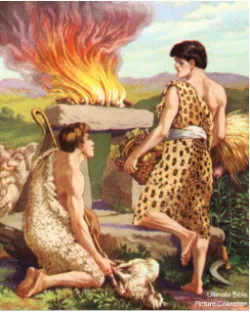
Gen 4:1 And Adam knew Eve his wife; and she conceived, and bare Cain, and said, I have gotten a man from the Lord. 2 And she again bare his brother Abel. And Abel was a keeper of sheep, but Cain was a tiller of the ground. 3 And in process of time it came to pass, that Cain brought of the fruit of the ground an offering unto the Lord. 16 And Cain went out from the presence of the Lord, and dwelt in the land of Nod, on the east of Eden. 17 And Cain knew his wife; and she conceived, and bare Enoch: and he builded a city, and called the name of the city, after the name of his son, Enoch.

Since the 1990s we have been warning that Chuck Swindoll is one of the fathers of what has more recently been called “cultural liberalism.” Swindoll’s grace is an invitation for believers to participate in the wicked pop culture in a largely non-critical fashion. His doctrine of “grace” opens the door to secular rock, Christian rock, dancing, drinking, mini-skirts, bikinis, petting, fornication, unisex fashion, marijuana, cursing, R-rated movies, violent occult video games, pornography, unfiltered social media, etc.

If there were only two people on Earth: Adam and Eve, then for the human race to “fill the Earth” at one point there must have been a brother and sister who would marry. This is not a perverse establishment by God since in that time there would have been no laws and problems with brother and sister marrying. This eventually changed certainly, but in the beginning there was nothing morally incorrect with that just like in the time of Abraham there was nothing wrong with his marrying his half-sister (Genesis 20:12), which marriage God blessed (Genesis 17:16), but later those kinds of marriages were restricted in the Law of Moses (Lev. 20:19).