Problem: Controversy has surrounded the death of Christ on the cross for almost two millennia. In the days of the apostle Paul, it served as a “stumbling block” to the Jews, and was “foolishness” to the Greeks (1 Corinthians 1:23). Throughout the past 2,000 years, men and women of all ethnicities have rejected the story of the crucified, resurrected Savior named Jesus for many objectionable reasons. Sadly, for some today, even the physical cross itself has become a stumbling block. Because of an alleged contradiction surrounding the actual words written on the cross of Christ, some have suggested that the message of the cross once preached by John, Paul, Peter, Philip, and others simply cannot be trusted. According to skeptics, the gospel writers disagree regarding what the title read that appeared on the cross above Jesus’ head.
Continue reading →
Month: November 2024
Mark 15:26 – Crossed Messages
Problem: Why do the inscriptions on Jesus’s cross differ among the four gospels?
Continue reading →
Mark 15:26 – Why is the inscription on the cross different in all the Gospels?
Problem: The wording of the accusation above Christ’s head on the cross is rendered differently in each Gospel account.
Continue reading →
Mark 15:25 – At What Hour was Jesus Crucified?
Problem: One allegation leveled by Bible critics is the difference that exists between Mark and John in their reporting of the hour of the crucifixion (McKinsey, 2000, pp. 295-296; Wells, 2013). Mark records that the Lord was crucified at the third hour (15:25), while John records that Jesus was tried before Pilate at the sixth hour (19:14)—which would seem to be after the time Mark says Jesus was crucified. The harmonization of this surface difference is quite simple and further underscores the sophistication of Bible inspiration.
Continue reading →
Mark 15:16,20 – Was the robe of Jesus Scarlet or Purple?
Problem: While the gospels agree that the Roman soldiers who mocked and tortured Jesus dressed him in a robe to taunt him, they seem to disagree on the color of the garment. Was the robe of Jesus purple or scarlet? As the sun set down, colors become muted. Let’s take a look:
Continue reading →
Mark 15:16-17 – Was the Robe Placed on Jesus Scarlet or Purple?
Problem: After being flogged with a dreadful Roman scourge, Jesus was taken by Pilate’s soldiers into the governor’s headquarters where the whole garrison gathered around Him. It was here that the soldiers placed a crown of thorns on His head, a reed in His hand, and a robe on His body. Skeptics maintain that a contradiction exists between the Gospel accounts because they describe the color of the robe differently. Whereas Matthew says that the soldiers “put a scarlet robe” on Jesus (27:27-28), Mark says that “they clothed Him with purple ” (15:16-17), and John states that the soldiers put “a purple robe” on Him (19:1-2). These differences have lead some to believe and advocate that the Gospel writers wrote under their own power with no help from a Higher Being, and thus they contradicted one another in their narratives. Because increasingly more people are swallowing such allegations blindly and rejecting the inerrancy of the Scriptures, logical answers are required. The question is, do such valid answers exist for the differences in the Gospel narratives concerning the robe placed upon Jesus after His scourging?
Continue reading →
Mark 15:7 – “Extra, Extra, Read all about it”
Problem: One of the most commonly neglected rules of interpretation that Bible critics overlook when attacking Scripture is that extra information is not necessarily contradictory information. When one Bible writer offers more details than another on a particular subject, it is inappropriate to assume that one of the writers is mistaken. When a journalist in the 21st century writes about a man on the side of the road who has just escaped death following a particular catastrophe, while another journalist writes how this same man and his wife (standing next to him) are suffering survivors of the devastating disaster, it does not mean that the first journalist was dishonest in his representation of truth. Similarly, countless times throughout Scripture, and especially within the gospel accounts, extra information is given that critics cannot justifiably prove to be contradictory.
Continue reading →
Mark 14:72 – How Many Times Did the Rooster Crow?
Problems: Perhaps the most famous alleged Bible contradiction centers on Peter’s triple denial of Jesus and the crowing of a rooster. For years, skeptics have charged that Mark’s account of this event blatantly contradicts the other gospel accounts, thus supposedly “proving” the imperfection of the Scriptures. Even Bible believers have questioned the differences surrounding this event, yet relatively few have taken the time to understand them. Whenever people ask us about Peter’s denials and the differences within the gospel accounts, we often fail to give an adequate answer to their questions (see 1 Peter 3:15). This lack of understanding and poor defense of God’s Word has led skeptics to become more confident in their position (that the Bible is not God’s Word), and has caused some Bible believers to abandon their position on the infallibility of the Scriptures.
Continue reading →
Mark 14:51-52 – Who was the naked man in Mark who fled
Problem: In Mark 14:51-52, there is a reference to someone who ran away naked after being seized by a large crowd (Matt. 26:47; Luke 47-53). The large crowd appeared to be a Roman cohort that worked with the chief priests and Pharisees (John 18:3-11). So, who was this naked man in Mark? It doesn’t say. Therefore, we can’t say who it was for sure. Though the other Gospels contain the account of Jesus’ arrest, this particular event is found only in Mark. This might be significant. Let’s take a look.
Continue reading →
Mark 14:61-62 – He Opened Not His Mouth
Problem: In what many consider to be the most well-known prophecy concerning the coming of the Messiah, the prophet Isaiah foretold of the sufferings that Christ would endure amid His trial and crucifixion, saying (as if it had already happened):
But He was wounded for our transgressions, He was bruised for our iniquities; the chastisement for our peace was upon Him, and by His stripes we are healed…. He was oppressed and He was afflicted, yet He opened not His mouth; He was led as a lamb to the slaughter, and as a sheep before its shearers is silent, so He opened not His mouth (53:5,7, emp. added).
Mark 14:30,68,72 – Cock-a-Doodle, One or Two?
Problem: How can we resolve the apparent differences among the Gospels regarding the number of times the rooster would crow? A passage that sheds light on this question is Mark 13:35, which states the following:
“Watch therefore, for you do not know when the master of the house is coming—in the evening, at midnight, at the crowing of the rooster, or in the morning.”
Continue reading →
Mark 14:30 – When Peter denied Christ, how many times did the rooster crow, once or twice?
Problem: Matthew and John (13:38) say before the rooster crows once, Peter will have denied the Lord three times. But Mark affirms that before the rooster crows twice Peter will deny Christ three times. Which account is right?
Continue reading →
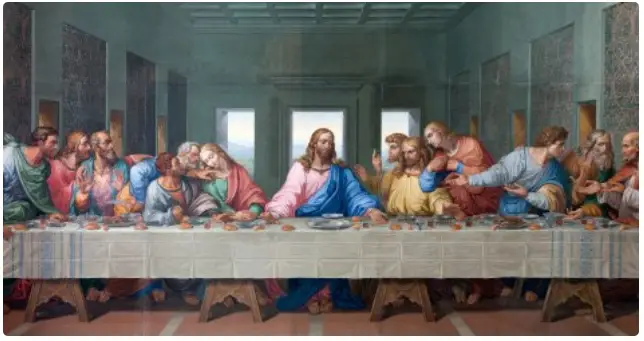
Mark 14:22-23 – The Order of the Lord’s Supper
Problem: In Matthew (26:26-27) and Mark’s (14:22-23) record of the institution of the Lord’s Supper, Jesus blessed the bread first and then the cup. However, Luke seems to give the opposite order with the cup mentioned first (22:17-19). Is this difference a discrepancy in which the inspired writers contradict each other?
Continue reading →
Mark 14:12 – Does the Bible Contradict Itself Regarding the Day of the Crucifixion?
Problem: According to Matthew, Mark, and Luke, before His crucifixion, Jesus sent disciples to prepare the Passover meal, killing the Passover lamb. They note that this task was completed on “the first day of the Feast of Unleavened Bread,” the 14th of Nisan on the Jewish calendar, the day before Jesus’ crucifixion (cf. Matthew 26:17; Mark 14:12; Luke 22:7)—identifying for us that the meal was prepared on a Thursday. In accordance with the Law of Moses, Jesus then ate the Passover meal that evening—Thursday night to the modern mind, but the beginning of the Jewish Friday to the Israelite (the Jewish day began at sunset). Jesus’ crucifixion then occurred the next day on Friday (the same day as the initial Passover meal to Jews), before the Jewish Sabbath Day began Friday evening (the Jews’ Saturday). [NOTE: While some believe the crucifixion, and hence the Passover meal, was earlier in the week, Mark 15:42, Luke 23:54, and Matthew 27:62 indicate that the crucifixion took place on Friday, “the day before the Sabbath,” with Jesus dying as “the Sabbath drew near.” Backing up through the synoptic narratives reveals Jesus being arrested the night before (Thursday night), while Jesus was in the Garden of Gethsemane immediately after His last supper with the disciples. The resurrection took place on Sunday, “three days” later, according to the Jewish idiomatic reckoning of the chronology (Mark 16:9; Matthew 28:1; Luke 24:1; cf. Lyons, 2004; Lyons, 2006; Bullinger, 1898, pp. 845-847; Robertson, 1922, pp. 289-291).] John, however, seems to indicate that Jesus’ crucifixion actually took place before the Passover even began (John 13:1; 18:28; 19:14). Thomas Nelson’s The Chronological Study Bible says, “The Synoptics [i.e., Matthew, Mark, and Luke—JM] present the Last Supper as being the Passover meal…. In John’s Gospel, the Last Supper was not the Passover meal” (2008, p. 1217). Jennifer Viegas, writing for Discovery News, said, “The synoptic gospels (Matthew, Mark, and Luke) indicate that Jesus died before nightfall on the 15th day of Nisan…. John’s gospel differs from the synoptics; apparently indicating that Jesus died before nightfall on the 14th day of Nisan” (2012). Respected biblical scholar J.W. McGarvey highlights the debate over the matter stating that,
Continue reading →

Mark 14:3-9 – How Many Times Was Jesus Anointed?
Problem: When we hear of alleged Bible contradictions, and then carefully examine the passages in question, we find that they are not really contradictions at all. One such supposed contradiction is that the Gospel accounts seem to indicate that Jesus was anointed before and after the Triumphal Entry. If the Gospels are recording a single event, then this would indeed be problematic, but that is not the case. In this article, we’ll examine the four accounts in Matthew, Mark, Luke, and John and demonstrate that there was not a single anointing of Jesus for his burial, but two or even three separate occasions of a woman anointing Jesus, and the first one was not done as a memorial for his burial.
Continue reading →