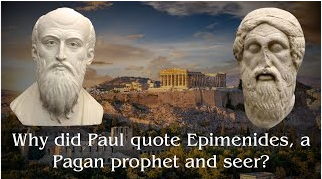
Paul

James 2:14-22 – Justification by Works and Justification by Faith, Did James contradict Paul?

James 2:14-22 – Justification by Works and Justification by Faith, Did James contradict Paul?

The Example of Abraham

Both Paul and James turned to the life of Abraham to illustrate justification. Paul writes, “For if Abraham was justified by works, he has something to boast about, but not before God. For what does the scripture say? Abraham believed God, and it was reckoned to him as righteousness” (Rom 4:2-3). James seems to contradict Paul when he writes, “Was not our father Abraham justified by works when he offered his son Isaac on the altar?” (James 2:21) A careful analysis will help shed light on this apparent disagreement.

Continue reading →
Posted by petra1000 in Bible Difficulty, Bible Study, Bible Teaching
Philemon 1:1 – Philemon and Slavery

Philemon 1:1 – Philemon and Slavery

Problem: American abolitionist, editor, orator, author, statesman, and reformer, Frederick Douglass, himself a former slave, was invited to deliver a speech in 1852 (eight years before the Civil War) to a women’s anti-slavery society in Rochester, New York. His assigned subject? “What, to the Slave, is the Fourth of July?” His remarks demonstrate forcefully that the Bible and the Christian religion were not to be blamed for the existence or perpetuation of slavery. In his brilliant oration, Douglass demonstrated that those “Christians” and churches in America at the time that used the Bible to sanction slavery were misinterpreting and misrepresenting it. He stated:

Continue reading →
Posted by petra1000 in Bible Difficulty, Bible Study, Bible Teaching
1 Tim 6:1 – Did Paul Endorse Slavery?

1 Tim 6:1 – Did Paul Endorse Slavery?

Problem: Thousands of years prior to the establishment of the Lord’s Church, and long before Paul addressed the conduct of Christian slaves in the first century, various forms of slavery were commonplace. In fact, virtually every ancient civilization used slaves.1 Slavery was prevalent enough in Babylon in the 18th century B.C. to be mentioned numerous times in the Code of Hammurabi.2 The Egyptians enslaved hundreds of thousands of Israelites in the 16th century B.C. (Exodus 1; cf. Numbers 1:46). Historians estimate that, by the time Paul wrote his New Testament epistles in the first century A.D., five to eight million slaves resided within the Roman Empire,3 including 15-25% of the total population of Italy.4

Continue reading →
Posted by petra1000 in Bible Difficulty, Bible Study, Bible Teaching
1 Tim 1:4 – “Avoid…Genealogies”?

1 Tim 1:4 – “Avoid…Genealogies”?

Problem: As most Bible students know, Scripture, particularly the Old Testament, contains several genealogies. Genesis chapter five gives the genealogy of Adam to Noah. Genesis 10 lists many of the descendants of Shem, Ham, and Japheth. Genesis 11 gives the genealogy of Shem to Abraham. Genealogies make up the first nine chapters of 1 Chronicles. What’s more, the New Testament opens with these words: “The book of the genealogy of Jesus Christ, the Son of David, the Son of Abraham” (Matthew 1:1, emp. added). In light of such extensive genealogies, some wonder why the apostle Paul instructed Timothy and Titus not to “give heed to…endless genealogies” (1 Timothy 1:4), but rather “avoid” them (Titus 3:9). One Bible critic has alleged that “if we follow this advice we would ignore most of the Bible” (Wells, 2008). Just how is it that we can trust a book that says to “avoid…genealogies,” when that same book contains several extensive genealogies? Is this a contradiction?

Continue reading →
Posted by petra1000 in Bible Difficulty, Bible Study, Bible Teaching
1 Thess 4:14-16 – Did Paul Make a Mistake Regarding the Resurrection?

1 Thess 4:14-16 – Did Paul Make a Mistake Regarding the Resurrection?

Problem: Near the close of his first letter to the church at Thessalonica, the apostle Paul addressed the subject of Christ’s Second Coming. He indicated that “the Lord Himself will descend from heaven with a shout, with the voice of an archangel, and with the trumpet of God” (4:16). The Christians in Thessalonica were not to be concerned with what would happen to Christians who had passed from this life prior to Jesus’ return. Departed Christians were not going to miss the Second Coming; God would take care of them. Paul noted that those “who are alive and remain until the coming of the Lord will by no means precede those who are asleep” (vs. 15). “[T]he dead in Christ will rise first” (vs. 16). Some have asked, however, if 1 Thessalonians 4:16 contradicts what Paul wrote just two verses previously where he indicated that “God will bring with Him those who sleep in Jesus” (vs. 14). How can those who will be the first to rise also be brought with Jesus? Did Paul make a blunder?

Continue reading →
Posted by petra1000 in Bible Difficulty, Bible Study, Bible Teaching
Col 1:24 – How did Paul help to fill up or complete what was lacking in the afflictions of Christ?

Col 1:24 – How did Paul help to fill up or complete what was lacking in the afflictions of Christ?

“I now rejoice in my sufferings for you, and fill up in my flesh what is lacking in the afflictions of Christ, for the sake of His body, which is the church” (Co1 1: 24 NKJV)

Verse: This verse is not speaking of Christ’s sufferings which took place on the cross in payment for our sins. There is nothing incomplete about our Lord’s atoning work on our behalf. He paid the price in full, as indicated by His victory cry, “It is finished!” (John 19:30). Every believer can rest fully in that wonderful finished work. Nothing can be added to it and nothing can be taken from it. It was exactly what was needed to save us from our sins and from an eternal hell.

Continue reading →
Posted by petra1000 in Bible Difficulty, Bible Study, Bible Teaching
Eph 6:5 – Did Paul Endorse Slavery?

Eph 6:5 – Did Paul Endorse Slavery?

Problem: Thousands of years prior to the establishment of the Lord’s Church, and long before Paul addressed the conduct of Christian slaves in the first century, various forms of slavery were commonplace. In fact, virtually every ancient civilization used slaves.1 Slavery was prevalent enough in Babylon in the 18th century B.C. to be mentioned numerous times in the Code of Hammurabi.2 The Egyptians enslaved hundreds of thousands of Israelites in the 16th century B.C. (Exodus 1; cf. Numbers 1:46). Historians estimate that, by the time Paul wrote his New Testament epistles in the first century A.D., five to eight million slaves resided within the Roman Empire,3 including 15-25% of the total population of Italy.4

Continue reading →
Posted by petra1000 in Bible Difficulty, Bible Study, Bible Teaching
Gal 3:17 – Did the Israelites stay 400 years (Gen. 15:13, Acts 7:6), 430 years (Ex. 12:40-41, Gal. 3:17), or 450 years (Acts 13:20) in Egypt?

Gal 3:17 – Did the Israelites stay 400 years (Gen. 15:13, Acts 7:6), 430 years (Ex. 12:40-41, Gal. 3:17), or 450 years (Acts 13:20) in Egypt?

Problem: In Galatians 3:17 Paul takes the 430 years of Exodus 12:40-41 to refer to the period from the day God appears to Abraham and he leaves for/into Canaan to the day of the Exodus. This is the most logical interpretation because Genesis 15:13 says his descendants will be “sojourners in a foreign land” for 400 years; Abraham is 75 when he leaves Haran (Gen. 12:4), and Isaac is born to him when he’s 100 (Gen. 21:5). This leaves us with 405 years technically, which is why some older commentators supposed that the 400 years began when Ishmael teased a 5-year-old Isaac (Gen. 20:9 – Ishmael laughed, presumably at Isaac’s expense). This is neither possible nor necessary to prove – 405 years can easily be rounded to 400 to carry the same sense, much like other ages and numbers are.

Continue reading →
Posted by petra1000 in Bible Difficulty, Bible Study, Bible Teaching
Gal 1:16-18 – When did Paul go to Jerusalem?

Gal 1:16-18 – When did Paul go to Jerusalem?

Problem: Three times in the book of Acts,the Bible student is informed that after Saul’s conversion to Christ in Damascus, he departed for Jerusalem. According to Acts chapter 9, Saul (also called Paul) “increased all the more in strength” following his baptism into Christ, and “confounded the Jews who dwelt in Damascus” (vs. 22). Then, when “many days were past…the disciples took him by night and let him down through the wall in a large basket” for fear of the Jews (vss. 23,25). Immediately following these verses, the text reads: “And when Saul had come to Jerusalem, he tried to join the disciples; but they were all afraid of him, and did not believe that he was a disciple” (vs. 26, emp. added). Add to these verses Paul’s respective statements to the Jerusalem mob (Acts 22:17) and to King Agrippa (Acts 26:20) regarding his journey from Damascus to Jerusalem, and Bible students get the impression that shortly after Paul‘s conversion in Damascus, he journeyed to Jerusalem. The problem with this reasoning is that Paul later wrote to the churches of Galatia, and indicated that he “did not immediately…go up to Jerusalem” following his calling to Christ (Galatians 1:16). Rather, he went to Arabia, back to Damascus, and then after three years he went up to Jerusalem (1:17-18). [NOTE: “Arabia” generally is taken as a reference to the vast peninsula which bears that name. Its northwestern boundaries reached almost to Damascus—Pfeiffer, 1979, p. 203.] Concerned Bible students want to know how these passages are harmonized? Did Paul go straight to Jerusalem shortly after his conversion, or three years later?
Continue reading →

Posted by petra1000 in Bible Difficulty, Bible Study, Bible Teaching
2 Cor 7:8 – What Is a Sorrowful Letter?

2 Cor 7:8 – What Is a Sorrowful Letter?

Problem: Evangelical scholarship is divided as to whether there was a lost letter (often called the “sorrowful letter”) in between 1 and 2 Corinthians. Paul writes, “For out of much affliction and anguish of heart I wrote to you with many tears” (2 Cor. 2:4), and later he writes, “For though I caused you sorrow by my letter, I do not regret it; though I did regret it—for I see that that letter caused you sorrow” (2 Cor. 7:8). When Paul refers to an earlier letter, is he referring to a lost letter, or is he referring to 1 Corinthians?
Continue reading →

Posted by petra1000 in Bible Difficulty, Bible Study, Bible Teaching
2 Cor 1:13 – Are Paul’s Letters Hard or Easy to Understand?

2 Cor 1:13 – Are Paul’s Letters Hard or Easy to Understand?

Problem: An alleged contradiction is said to occur between 2 Corinthians 1:131 and 2 Peter 3:16. One passage states that what was written could be understood, and the other states that there are things which are hard to understand. Is this an irreconcilable contradiction? The easiest way to demonstrate that there is no contradiction is to examine the extended context of both passages. When looked at in this way, it is clear that different things are being discussed.
Continue reading →

Posted by petra1000 in Bible Difficulty, Bible Study, Bible Teaching
1 Cor 15:33 – By quoting a pagan poet as part of Scripture, doesn’t Paul thereby pronounce this pagan writing a part of Scripture?

1 Cor 15:33 – By quoting a pagan poet as part of Scripture, doesn’t Paul thereby pronounce this pagan writing a part of Scripture?

Problem: Paul quoted a Cretan who said that “Cretans are always liars” (1:12). But if this was said by a Cretan and Cretans always lie, then he too was lying. But if this Cretan was lying when he said Cretans always lie, then Cretans do not always lie and there is a lie in the Scripture. If, on the other hand, this Cretan was telling the truth about Cretans, then Cretans do not always lie, at least not the one who said this. In either event, by incorporating this statement in Scripture, the apostle seems to have included a falsehood.

Continue reading →

Posted by petra1000 in Bible Difficulty, Bible Study, Bible Teaching