Problem: In Matthew, the mother of James and John made a request of Jesus. However, Mark states that it was James and John who came to Jesus to make their request.
Continue reading →
24
Oct
2024

Problem: In Matthew, the mother of James and John made a request of Jesus. However, Mark states that it was James and John who came to Jesus to make their request.
Continue reading →
Problem: The rich young ruler called Jesus “Good Teacher,” and Jesus rebuked him, saying, “Why do you call Me good? No one is good but One, that is, God.” Yet on other occasions Jesus not only claimed to be God (Mark 2:8–10; John 8:58; 10:30), but He accepted the claim of others that He was God (John 20:28–29). Why did Jesus appear to deny that He was God to the young ruler?
Continue reading →

Problem: The Bible’s teaching on the reality of eternal punishment for unbelievers has perhaps “made” more atheists than any other teaching of Scripture. After expressing that he did not “believe one can grant either superlative wisdom or the superlative goodness of Christ as depicted in the Gospels,” popular early-20th-century agnostic Bertrand Russell indicated that he was not concerned about what other people said about Christ, but “with Christ as He appears in the Gospels.”1 How so? In his widely distributed pamphlet “Why I Am Not a Christian,” Russell argued, “There is one very serious defect in Christ’s moral character, and that is that He believed in hell. I do not myself feel that any person who is really profoundly humane can believe in everlasting punishment. Christ certainly as depicted in the Gospel did believe in everlasting punishment.”2
Continue reading →
Problem: After Jesus prophesied during His earthly ministry that some would live to see the establishment of God’s kingdom, the first two books of the New Testament indicate six days expired before Peter, James, and John were led up on a high mountain to witness the transfiguration of Jesus (Matthew 16:28-17:2; Mark 9:1-2). Luke’s account, on the other hand, says that Jesus’ transfiguration occurred “about eight days after” Jesus prophesied of the approaching kingdom’s establishment (9:27-29). Skeptics charge that this difference in the time elapsed between the two events constitutes an obvious error. They profess that such textual differences should lead the honest person to admit that the Bible contains contradictions, and thus is not the inerrant Word of God.
Continue reading →
Problem: According to The Skeptics Annotated Bible, in Mark 9:1, “Jesus falsely prophesies that the end of the world will come within his listeners’ lifetimes.”1 Skeptic Dennis McKinsey calls this prophecy2 “one of those classic predictions that has haunted his supporters ever since, forcing them to concoct an endless number of rationalizations to explain its failure.”3
Continue reading →
Problem: Did Jesus fail to correctly predict that people standing with Him would “not taste death” until they saw the arrival of the kingdom of God? The answer is, of course, no, He did not fail. There are two reasons why what Jesus said did not fail. First, let’s examine the scriptures under consideration.
Continue reading →

Problem: The most frequent reference to Jesus’ resurrection reveals that He rose from the grave on the third day of His entombment. Matthew, Mark, and Luke all record Jesus as prophesying that He would arise from the grave on this day (Matthew 17:23; Mark 9:31; Luke 9:22). The apostle Paul wrote in his first epistle to the Corinthians that Jesus arose from the grave “the third day according to the Scriptures” (1 Corinthians 15:4). What’s more, while preaching to Cornelius and his household, Peter taught that God raised Jesus up “on the third day” (Acts 10:40, emp. added). The fact is, however, Jesus also taught (and Mark recorded) “that the Son of Man” would “be killed, and after three days rise again” (Mark 8:31, emp. added). Furthermore, Jesus elsewhere prophesied that He would be in the heart of the Earth for “three days and three nights” (Matthew 12:40). So which is it? Did Jesus rise from the dead on the third day or after three days?
Continue reading →
Problem: A gentleman who was struggling with his beliefs in the inerrancy of the Bible recently contacted our offices questioning why Jesus told the scribes and Pharisees that “no sign shall be given to this generation” (Mark 8:12; cf. Matthew 12:39; 16:4; Luke 11:29). Since other scriptures clearly teach that Jesus worked “many signs” (John 12:37; 20:30-31; 3:2; Acts 2:22), how could Jesus truthfully and consistently say, “no sign shall be given to this generation”? According to certain Bible critics, Jesus was a false prophet since His “prediction that no sign would be given to that generation is clearly false” (McKinsey, 1995, p. 114; cf. Wells, 2010). How can a Christian reasonably and biblically respond to such an assertion?
Continue reading →
Problem: For Herod had laid hold of John and bound him, and put him in prison for the sake of Herodias, his brother Philip’s wife. Because John had said to him, “It is not lawful for you to have her.” And although he wanted to put him to death, he feared the multitude, because they counted him as a prophet. (Matthew 14:3–5, NKJV)
Continue reading →
Perhaps the most difficult alleged Bible contradiction that we have been asked to “tackle” at Apologetics Press was presented to us some time ago by the mother of a dear friend. She asked, “When Jesus sent out the twelve apostles on what is commonly called the ‘limited commission,’ did He instruct them to take staffs or not?” Her question was the result of studying the three following parallel passages in the synoptic Gospels (the difficult portions are in bold type).
“Provide neither gold nor silver nor copper in your money belts, nor bag for your journey, nor two tunics, nor sandals, nor staffs (literally, “a staff”); for a worker is worthy of his food” (Matthew 10:9-10).
“He commanded them to take nothing for the journey except a staff—no bag, no bread, no copper in their money belts—but to wear sandals, and not to put on two tunics” (Mark 6:8-9).
“And He said to them, ‘Take nothing for the journey, neither staffs (literally, “a staff”) nor bag nor bread nor money; and do not have two tunics apiece’ “ (Luke 9:3).
A cursory reading of the above passages admittedly is somewhat confusing. Matthew and Luke seem to agree that Jesus prohibited the disciples from taking a staff on their journeys, while Mark appears to give them permission to take one. Furthermore, although Luke does not record Jesus’ command regarding sandals, some have concluded that Matthew and Mark also contradict each other on this point. To use the words of Steve Wells, author of The Skeptic’s Annotated Bible, “In Matthew’s gospel, Jesus tells his disciples to go barefoot and take no staff. But the Jesus in Mark’s gospel (6:8-9) tells them to wear sandals and carry a staff” (emp. added). Actually then, the question at hand is about staffs and sandals, even though Luke mentioned only staffs.
The differences between Matthew and Mark are explained easily when one acknowledges that the writers used different Greek verbs to express different meanings. The word “provide” (NKJV) in Matthew 10:9 is translated from the Greek ktesthe, which is derived from ktaomai. According to Danker, Arndt, and Gingrich, in their Greek-English Lexicon of the New Testament, this verb means “to gain possession of, procure for oneself, acquire, get” (p. 572). Based upon these definitions, the New American Standard Version used the English verb “acquire” in Matthew 10:9 (“Do not acquire….”), instead of “provide” (as in the NKJV). Thus, according to Matthew, Jesus is saying (in essence): “Go as you are and do not take the time to go procure for yourself anything in addition to what you already have.” As Mark indicated, the apostles were to “take” (airo) what they had, and go. The apostles were not to waste precious time gathering supplies (extra apparel, staffs, shoes, etc.) or making preparations for their trip, but instead were instructed to trust in God’s providence for additional needs. Jesus did not mean for the apostles to discard the staffs and sandals they already had; rather, they were not to go and acquire more.
To illustrate this point using a modern day scenario, consider the CEO who came to his Personnel Director near the end of the day and said that he needed her to fly to Los Angeles on a business trip immediately. If he told the director not to acquire anything for this urgent trip, including clothes, shoes, or make-up, she would know that he meant not to take anything extra. Obviously the CEO did not intend for the Personnel Director to take off her shoes, clothes, and the make-up she already was wearing in order to make the trip. Furthermore, if her boss came back five minutes later (to ensure that she understood his instructions clearly) and stated, “Hurry. The plane is leaving in one hour. Don’t take anything with you except what you are wearing,” the Personnel Director would conclude the same thing she did the first time—do not take anything extra. The CEO said the same thing using two different phrases. Similarly, the wording in Matthew and Mark represent two different ways of saying virtually the same thing.
Most apologists and biblical commentators discontinue their discussion of these parallel passages at this point. They explain the difference between Matthew and Mark’s account of Jesus sending out the Twelve, but they omit Luke’s account. In order to answer the skeptic’s criticism adequately, however, Luke’s account must be included in this discussion. Otherwise, one still is left with an unanswered alleged contradiction. The differences surrounding Luke and Mark’s account are explainable, but it takes effort on the part of the reader to comprehend them. [The following facts must be read carefully in order to understand how the differences in these accounts do not point toward a contradiction.]
As is obvious from a comparison of the verses in Matthew and Luke, they are recording the same truth—that the apostles were not to spend valuable time gathering extra staffs—only they are using different words to do so.
“Provide (Greek ktaomi) neither gold nor silver…nor staffs” (Matthew 10:9-10, emp. added).
“Take (Greek airo) nothing for the journey, neither staffs” (Luke 9:3, emp. added).
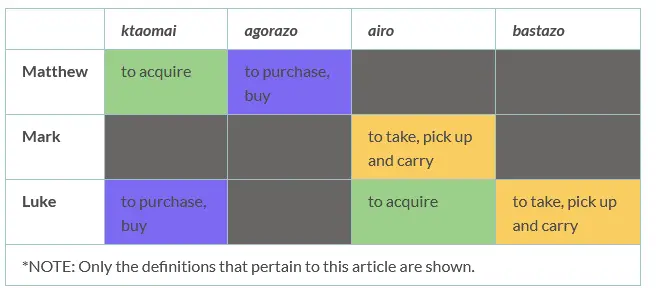
Luke did not use ktaomi in his account because he nearly always used ktaomi in a different sense than Matthew did. In Matthew’s account, the word ktaomai is used to mean “provide” or “acquire,” whereas in the books of Luke and Acts, Luke used this word to mean “purchase, buy, or earn.” Notice the following examples of how Luke used this word.
“I fast twice a week; I pay tithes of all that I get” (ktaomai) [Luke 18:12, emp. added, NAS]
“Now this man purchased (ktaomai) a field with the wages of iniquity (Acts 1:18, emp. added).
“Your money perish with you, because you thought that the gift of God could be purchased (ktaomai) with money!” (Acts 8:20, emp. added).
The commander answered, “With a large sum I obtained (ktaomai) this citizenship” (Acts 22:28, emp. added).
[Luke 21:19 is the only place one could argue where Luke may have used ktaomai to mean something other than “purchase, buy, or earn,” but even here there is a transactional notion in it (Miller, 1997)].
When Luke, the beloved physician (Colossians 4:14), used the word ktaomai, he meant something different than when Matthew, the tax collector, used the same word. Whereas Luke used ktaomai to refer to purchasing or buying something, Matthew used the Greek verb agorazo (cf. Matthew 14:15; 25:9-10; 27:6-7). Matthew used ktaomai only in the sense of acquiring something (not purchasing something). As such, it would make absolutely no sense for Luke to use ktaomai in his account of Jesus sending out the apostles (9:3). If he did, then he would have Jesus forbidding the apostles to “purchase” or “buy” money [“Buy nothing for the journey, neither staffs nor bag nor bread nor money….”]. Thus, Luke used the more general Greek verb (airo) in order to convey the same idea that Matthew did when using the Greek verb ktaomai.
Just as ktaomai did not mean the same for Luke and Matthew, the Greek word airo (translated “take” in both Mark 6:8 and Luke 9:3) often did not mean the same for Luke and Mark (see Miller, 1997). [Understanding this simple fact eliminates the “contradiction” completely, for unless the skeptic can be certain that Mark and Luke were using the word in the same sense, he cannot prove that the accounts contradict each other.] Mark consistently used airo in other passages throughout his gospel to mean simply “take” or “pick up and carry” (2:9; 6:29; 11:23; 13:16). That Luke (in 9:3) did not mean the same sense of airo as Mark did (in 6:8) is suggested by the fact that in Luke 19:21-22 he used this same verb to mean “acquire.” Another piece of comparative data between Mark and Luke is that when Mark recorded Jesus informing His listeners that to be His disciple one had to “take up his cross” (Mark 8:34), he used the word airo. Luke, on the other hand, used the Greek word bastazo (14:27) [Miller, 1997].
Without going any further with these language comparisons, one simply must understand that the Greek language (like most languages) is flexible enough so that sometimes two writers can use the same word to mean different things, and sometimes they can use different words to mean the same thing (as indicated by the following chart,* which serves as a summary of the comparisons and contrasts made in this article).
In case you think such “language leeway” in the Greek sounds absurd, remember that this flexibility appears frequently in the English language. Consider two basketball coaches who are commenting on a player. One says, “He is bad;” the other says, “He is good.” The coaches may be using two different words to mean the same thing. The truth is, in some contexts the words “bad” and “good” are opposites, in other situations they are synonymous.
Although many have been misled about the differences regarding Jesus’ instructions when sending out His apostles on the limited commission, the truth is that Matthew, Mark, and Luke were all saying the same thing: “Hurry up and get moving!”
Problem: Did Jesus tell His disciples to take a staff? Or did He tell them to leave them behind?
Continue reading →
Problem: According to Mark 6:5, while Jesus was in His hometown of Nazareth, “He could do no mighty work there, except that He laid His hands on a few sick people and healed them” (emp. added). Based upon this statement, some have concluded that Jesus must have lacked the power to work all manner of miracles in His hometown. Allegedly, Jesus was not God and the Bible’s depiction of Him is contradictory.
Continue reading →
Problem: Some claim the Bible reveals that Jesus did not possess superior knowledge. As “proof,” these skeptics refer to such passages as Mark 5:25-34 and Matthew 26:39. In Mark 5, it is recorded that after Jesus’ garment had been touched, He asked the crowd, “Who touched my garments?” (5:30). In Matthew 26, Jesus, praying to the Father, said, “If it is possible, let this cup pass from me” (26:39). Do such statements reveal ignorance on the part of Jesus? Was His knowledge no greater than yours and mine? What is the truth of the matter?
Continue reading →
Problem: After healing the men who were possessed with demons on the east shore of the Sea of Galilee (Matthew 8:28-34), Jesus passed over to the other side and “came into his own city” (probably Capernaum—Matthew 9:1). Soon thereafter, a man by the name of Jairus, one of the rulers of the synagogue, fell at Jesus’ feet and worshipped Him saying, “My daughter has just died, but come and lay Your hand on her and she will live” (Matthew 9:18). Normally, we would continue telling this wonderful story and rehearse how Jesus raised the twelve-year-old girl from the dead. However, the purpose of this article is to answer the skeptics who claim that a contradiction exists between Matthew’s account of this story and the accounts recorded by Mark and Luke. Whereas Matthew records Jairus telling Jesus, “My daughter has just died” (Matthew 9:18, emp. added), the other two accounts indicate that his daughter was “at the point of death” (Mark 5:23, emp. added) and that “she was dying” (Luke 8:42, emp. added). Critics of the Bible’s inerrancy assert that the difference in these accounts represents a blatant contradiction.
Continue reading →
Problem: God’s Word is perfect and cannot contradict itself; therefore, whenever we see two or more passages of Scripture that appear to contradict each other, we need to study the passages in more detail. We must make sure we are examining the same event, do not take words out of context, recognize any figures of speech or poetic language being used, and be aware of any translational issues of words or phrases, from the Hebrew, Aramaic, or Greek into English.