Problem: The most frequent reference to Jesus’ resurrection reveals that He rose from the grave on the third day of His entombment. Matthew, Mark, and Luke all record Jesus as prophesying that He would arise from the grave on this day (Matthew 17:23; Mark 9:31; Luke 9:22). The apostle Paul wrote in his first epistle to the Corinthians that Jesus arose from the grave “the third day according to the Scriptures” (1 Corinthians 15:4). What’s more, while preaching to Cornelius and his household, Peter taught that God raised Jesus up “on the third day” (Acts 10:40, emp. added). The fact is, however, Jesus also taught (and Mark recorded) “that the Son of Man” would “be killed, and after three days rise again” (Mark 8:31, emp. added). Furthermore, Jesus elsewhere prophesied that He would be in the heart of the Earth for “three days and three nights” (Matthew 12:40). So which is it? Did Jesus rise from the dead on the third day or after three days?
Continue reading →
petra1000
1 Cor 15:3-4 – For Whom Did Christ Die
Problem: What was the gospel message which Paul preached to lost men? The Apostle Paul very specifically sets forth the gospel that he preached in 1 Corinthians 15:1-4. In 1 Corinthians 15:3 we learn that the central part of the gospel message is that “Christ died for our sins according to the Scriptures.” In 1 Corinthians 15:1 Paul says that this is the very gospel which he preached to the Corinthians, and obviously when they first heard the gospel they were unsaved and unregenerate, and Paul did not know which ones in his audience were among the elect. He just knew that God had “much people” in this city (Acts 18:10). To these unsaved Corinthians, including some who would never be saved, Paul preached this gospel: “Christ died for OUR sins (yours and mine)!”
Social Media a Forum for Heresy and Nuttiness
We live at the end of the church age in the depths of apostasy at the end of the church age. The little leaven that began in the days of the apostles has leavened “Christendom” for two millennia, until the whole is almost leavened.
Continue reading →
UFOs – What is The Christian View of Them?
To deal with the subject of UFOs I have taught people for over thirty years to ask three very important questions. Almost everyone Christian or not has asked questions regarding UFOs. What I noticed years ago was that unbelievers only asked two of the three questions. Believers are compelled by the scripture itself to ask all three questions. It is the answer to the third question that raises a warning flag on the whole matter.
Continue reading →
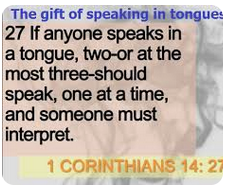
1 Cor 14:17-40 – The Regulation of Tongues in the Church
Problem: Paul, in correcting the misuse of tongues in Corinth, set forth certain regulations for the proper use of tongues in the assembly. The governing principles behind all of these regulations are summed up in verse 26 (“Let all things be done unto edifying”) and in verse 40 (“Let all things be done decently and in order”). Paul did not forbid the Corinthians to speak with tongues (verse 39) but he did forbid any tongues-speaking contrary to the rules which he set forth.
American Churches ? Entertaining or Truth
I almost stopped first at a larger church only a block from away from the little church I visited. The large brick church had a parking lot fairly full of cars and several people were going in as I drove by. I can?t say what made me keep driving but only a block away was a little white church with two people sitting on the front steps. As I slowed down to look at the church the two people waved to me and smiled. They beckoned for me to come in. I did.
Continue reading →
1 Cor 14:33 – Confused Critics, Not God
Problem: One of the many criticisms that skeptics have leveled against the Bible writers is that the Scriptures paint a contradictory picture of God, specifically regarding whether or not God “authors confusion.” Since God confused the language of man at Babel (11:1-9; apparently in the days of Peleg—Genesis 10:25), then, allegedly, Paul’s claim that “God is not the author of confusion” (1 Corinthians 14:33) must be erroneous. How could He purposefully confuse mankind, while at the same time not be the “author of confusion”?
Continue reading →
Disasters–What Did Jesus Say to Us?
DISASTERS-WHAT DID JESUS SAY?
(Luke 13:1-5)
What did Jesus say to do in a time of disaster? There were two disasters that The Lord talked about.
The first one was about those who lost their lives because of Pilate, and also those who lost their lives because the Tower of Siloam fell on them.
Continue reading →
I Cor 14:21-26 – The Purpose of Tongues in the Assembly
Problem: What were tongues for? What was the purpose of this gift? The one place in the New Testament which clearly sets forth the purpose of tongues is 1 Corinthians 14:22: “Wherefore, tongues are for a sign . . .” The preposition translated “for” (eis) here denotes purpose. The verse is introduced by the particle “wherefore” (hoste), which means “for this reason, therefore.” Paul’s explanation in verse 22 concerning the purpose of tongues is actually an inference based upon his words in verse 21. Therefore, the key to understanding the purpose of tongues must be found in 1 Corinthians 14:21. Verse 21 begins with these important words, “In the law it is written . . .”
Jesus Died For Our Sicknessess Also
Look closely at the words ?griefs? and ?sorrows? in Isaiah?s prophecy below. Scholarship demands that both these words should have been rendered by our English words ?sicknesses? and ?pains.?
Continue reading →
1 Cor 14:1-20 – The Value of Tongues in The Assembly
1 Corinthians 14:1-20
Follow after charity [love], and desire spiritual gifts, but rather that ye may prophesy (1 Corinthians 14:1).
Continuing his movement of thought from the previous chapter, Paul sets forth a command: “Follow after [run after, pursue, chase, as a hunter would chase after prey or as a runner would run to the finish line to receive a prize] love.” The reason is obvious: “Love edifies [builds up]” (1 Corinthians 8:1). Love seeks to please his neighbor for his good to edification (Romans 15:2). Love seeks the highest and best for the person loved. And God seeks the highest and best for His assembly. Indeed the highest and best gift is that of prophecy (forthtelling and communicating God’s truth to God’s people). Prophecy excels in edificational value!
What is Salvation?
Every rational human being recognizes that he has a “Threefold Need.” (1). In regard to YESTERDAY. Why? Because “yesterday” was the day of SIN. What are we to do with the past years? We cannot live them over again, nor balance them by “Works of” Supererogation.” (2). In regard to TO-DAY. If I have managed to provide for the sin of yesterday, what am I to do for today? For today if there is no change in my nature I will sin as yesterday. (3). In regard to TOMORROW. Suppose that I have been able to make provision for the past and the present, for yesterday and today, what am I to do for tomorrow? for tomorow will come with the same old forms of temptation, the same old suggestions to evil, the same helplessness to overcome sin as in the past. From this we see that we need PARDON for the Past, PURITY for the Present, and POWER for the Future. Where are we to get them?
Continue reading →
1 Cor 13:11 – Act Like a Child
Problem: Why does the Bible say to be like a child, but then to put away childish things?
Jesus told His followers that they were supposed to become like little children, yet Paul told his readers to stop acting like children.
Continue reading →
Jesus Christ. The First , The Last, The Eternal.
Luke 17:20-17:24 (NIV, NIRV, TNIV, KJV)
Jesus Christ. The First , The Last, The Eternal. Grace be to you and peace from God the Father, and from our Lord Jesus Christ,Who gave himself for our sins, that he might deliver us from this present evil world, according to the will of God and our Father: To whom be glory for ever and ever. Amen.
Continue reading →
1 Cor 13:8 – Temporary Sign Gifts
Problem: The spiritual gifts listed by Paul in 1 Corinthians 12:8-11 are grouped into the three categories.
Category 1
the word of wisdom
the word of knowledge
Category 2
Faith
gifts of healing
working of miracles
prophecy
discerning of spirits
Category 3
kinds of tongues
interpretation of tongues
Continue reading →