Month: January 2025

Luke 6:12-20 – Did Jesus Go Up or Down the Mountain?

Problem: The Gospel of Matthew indicates Jesus “went up on a mountain” before preaching the famous Sermon on the Mount. Meanwhile, the Gospel of Luke reveals that Jesus “came down” before delivering this message. Furthermore, Matthew showed that Jesus “was seated” before teaching while Luke stated that Jesus “stood on a level place.” How can both accounts possibly be accurate? Let’s take a look at the two passages and then find out why these are not contradictions.
Continue reading →

Posted by petra1000 in Bible Difficulty, Bible Study, Bible Teaching

Luke 6:3-4 – Did King David Break the Law in 1 Samuel 21?

Problem: In response to the Pharisee’s accusation that Jesus’ disciples had broken the Law of Moses by plucking heads of grain on the Sabbath, the master Teacher called His critics’ attention to the time when King David was hungry and “entered the house of God and ate the showbread which was not lawful for him to eat, nor for those who were with him, but only for the priests” (Matthew 12:4). Jesus was referring to the incident recorded in 1 Samuel 21 when David feared for his life, fled from King Saul, and ate the holy bread of the Tabernacle. One questioner recently asked: “Was it not the case that David, in 1 Sam. 21-22, had divine authorization to eat the showbread which was not otherwise lawful? Three times in chapter 22, it is said that the priest, who gave the showbread to David, ‘inquired of the Lord’ for him. Did David not acquire permission from God before getting the showbread?” If so, how could Jesus say that David’s actions were “unlawful” (Matthew 12:4; Mark 2:26; Luke 6:4)?
Continue reading →

Posted by petra1000 in Bible Difficulty, Bible Study, Bible Teaching

Luke 5:30-33 – Who, Exactly, Asked the Question?

Problem: Why does Matthew 9:14 say that the disciples of John asked Jesus about fasting, while Luke 5 indicates that the Pharisees and their scribes asked Jesus this question? Isn’t this a contradiction?
Continue reading →

Posted by petra1000 in Bible Difficulty, Bible Study, Bible Teaching

Luke 4:34, 5:15 – If Jesus Is God, Why Was It a Secret?

Problem: Though not a secret, This post shows that the God-man Jesus ministered on earth to maximize the impact of His salvation message.

And He strictly warned him and sent him away at once, and said to him, “See that you say nothing to anyone; but go your way, show yourself to the priest, and offer for your cleansing those things which Moses commanded, as a testimony to them.” (Mark 1:43–44; cf. Mark 1:23–25; Matthew 16:16; Luke 4:34; 5:14)
Continue reading →

Posted by petra1000 in Bible Difficulty, Bible Study, Bible Teaching

Luke 4:16-30 – How was Jesus rejected?

Problem: There are differences in Jesus’ rejection between the Synoptic gospels. Matthew and Mark place this event in the middle of Jesus’ ministry, but Luke places it at the beginning. Moreover, Matthew and Mark state that Jesus left quietly (Mt. 13:58; Mk. 6:5), while Luke explains he was chased by a mob (Lk. 4:30). What should we make of these? Are they contradictions?
Continue reading →
Posted by petra1000 in Bible Difficulty, Bible Study, Bible Teaching

Luke 4:25-26 – Elijah and the Drought

Problem: Twice in the New Testament one can read of the drought of Eljiah’s day that lasted for three and a half years. Jesus once referred to this famine while addressing fellow Jews in His hometown of Nazareth (Luke 4:25-26), while James mentioned it near the end of his epistle (5:17-18). Some have a problem with the drought of “three years and six months,” because 1 Kings 18:1 says: “The word of the Lord came to Elijah, in the third year, saying, ‘Go, present yourself to Ahab, and I will send rain on the earth’” (emp. added). Soon thereafter, “there was a heavy rain” (18:45; cf. 18:15). The question is, did the rain come “in the third year” (1 Kings 18:1, emp. added) or after “three years and six months” (Luke 4:25; James 5:17)?
Continue reading →

Posted by petra1000 in Bible Difficulty, Bible Teaching

Luke 4:3-12 – Why do Luke and Matthew place Satan’s conversation out of order?

Problem: Mark merely refers to the temptation of Jesus (Mk. 1:12-13), but doesn’t give specifics. John omits the event altogether. Luke and Matthew both describe the temptation, yet they contain the conversation in a different order:
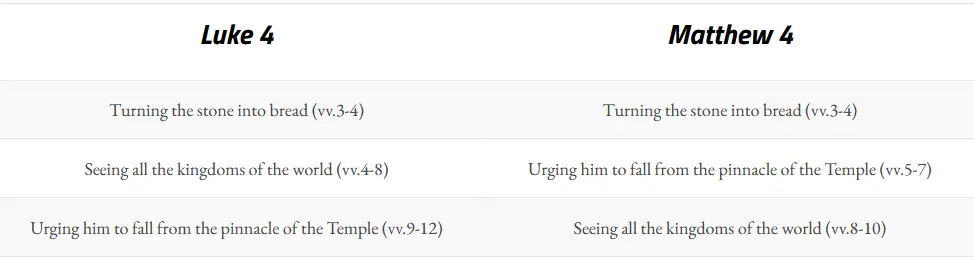
Is this a contradiction?

Solution: No. Commentators believe that Matthew most likely captured the temptations chronologically, while Luke captured them topically. Craig Evans writes, “Fitzmyer[1] believes that Matthew has retained the original order, which is reflected in the logical progression of the temptations (from desert-floor, to pinnacle of temple, to a high mountain) and in the descending order of Jesus’ quotations from Deuteronomy.”[2] Nolland writes, “Most [commentators] rightly recognize the priority of the Matthean order which allows the first two closely related temptations to be juxtaposed, and sets the quotations from Deuteronomy in simple reverse order.”[3]

Ancient historians did not hold chronological ordering as a priority. For instance, if someone asked you, “How was high school for you?” You might say, “I graduated with a 4.0, I played football my sophomore year, and I was in a major car accident when I got my license.” Of course, this account is not chronological. But based on this, would it be reasonable for them to call you a liar for recounting your experience in this way? Of course not. We can record events topically and still tell them truly.

NT scholar Richard Longenecker notes that almost all ancient historians wrote topically, rather than chronologically. He writes, “In writing their histories the ancients frequently grouped their material per species, without always specifying chronological relationships.”[4] He cites a number of examples of ancient historians who adopted this view: (1) Satyrus’ Life of Euripides, (2) Plutarch’s Parallel Lives, (3) all Roman historians besides Tacitus, and (4) Suetonius’ Augustus.[5]

Why do Matthew and Luke choose to recount this event in two different ways? Luke most likely wanted to emphasize Jesus going to Jerusalem. Jesus ultimately defeats the temptations of Satan by going to Jerusalem to die on the Cross. We agree with Darrell Bock who writes, “Luke will highlight Jesus’ journey to Jerusalem (9:51–19:44), the nation’s central city, as the place Jesus is fated to go and suffer death. So Satan’s offer to circumvent that suffering is a truly sinister effort to thwart God’s plan. The placement of this temptation last foreshadows the strategic role Jerusalem will have in Luke’s story.”[6] Craig Evans adds, “Jerusalem plays a significant part in Luke’s story of Jesus. Only in Luke’s Gospel does Jesus “set his face toward Jerusalem” (9:51) and then take the next ten chapters or so to get there (i.e., 9:51–19:27). The importance of Jerusalem for Jesus is hinted at in Luke 13:33: “surely no prophet can die outside Jerusalem!” (see commentary on 13:31–35 below). For Luke, Jerusalem is the city of Jesus’ destiny, and therefore it is appropriate that the temptation scenes reach their climax there.”[7]

On the other hand, Leifeld holds that Matthew might want to emphasize the importance of the Gentiles or nations in Jesus’ plan. After all, Matthew’s gospel ends with the Great Commission to “all nations.” He writes, “It may be that Matthew preferred to conclude with a kingdom reference. Possibly Luke wants to center on the city of Jerusalem (v. 9), which Matthew does not mention by name, because of his theme of the progression of the gospel from Jerusalem to the Gentile nations.”[8] Surely both views are possible.

[1] Joseph A. Fitzmyer, The Gospel According to Luke, 2 vols., AB 28 and 28a. Garden City: Doubleday, 1985. 507-508.

[2] Evans, C. A. (1990). Luke (p. 65). Grand Rapids, MI: Baker Books.

[3] Nolland, J. (2002). Luke 1:1–9:20 (Vol. 35A, p. 177). Dallas: Word, Incorporated.

[4] Longenecker, Richard. The Acts of the Apostles. In F. E. Gaebelein (Ed.), The Expositor’s Bible Commentary, Volume 9: John and Acts (F. E. Gaebelein, Ed.). Grand Rapids, MI: Zondervan Publishing House. 1981. 213.

[5] Longenecker, Richard. The Acts of the Apostles. In F. E. Gaebelein (Ed.), The Expositor’s Bible Commentary, Volume 9: John and Acts (F. E. Gaebelein, Ed.). Grand Rapids, MI: Zondervan Publishing House. 1981. 213.

[6] Bock, D. L. (1994). Luke (Lk 4:1). Downers Grove, IL: InterVarsity Press.

[7] Evans, C. A. (1990). Luke (p. 65). Grand Rapids, MI: Baker Books.

[8] Leifeld, W. L. (1984). Luke. In F. E. Gaebelein (Ed.), The Expositor’s Bible Commentary: Matthew, Mark, Luke (Vol. 8, p. 864). Grand Rapids, MI: Zondervan Publishing House.


Posted by petra1000 in Bible Difficulty, Bible Study, Bible Teaching

Luke 4:25-26 – Elijah and the Drought

Problem: Twice in the New Testament one can read of the drought of Eljiah’s day that lasted for three and a half years. Jesus once referred to this famine while addressing fellow Jews in His hometown of Nazareth (Luke 4:25-26), while James mentioned it near the end of his epistle (5:17-18). Some have a problem with the drought of “three years and six months,” because 1 Kings 18:1 says: “The word of the Lord came to Elijah, in the third year, saying, ‘Go, present yourself to Ahab, and I will send rain on the earth’” (emp. added). Soon thereafter, “there was a heavy rain” (18:45; cf. 18:15). The question is, did the rain come “in the third year” (1 Kings 18:1, emp. added) or after “three years and six months” (Luke 4:25; James 5:17)?
Continue reading →

Posted by petra1000 in Bible Difficulty, Bible Study, Bible Teaching

Luke 4:12 – What Exactly Did Jesus Say?

Problem: Numerous times in the gospel accounts, the Bible writers recorded statements made by Jesus while He was on Earth. Puzzling to some Bible readers is the fact that, although Bible writers frequently recorded the same statements, they are not exactly (word-for-word) alike. For example, whereas Matthew recorded that Jesus told Satan, “It is written again (palin gegrapti), ‘You shall not tempt the Lord your God’” (4:7), Luke wrote: “It has been said (eiratai), ‘You shall not tempt the Lord your God’” (4:12). Although this difference is considered minor, and is referring to the same thing (the Old Testament), Matthew and Luke still recorded Jesus’ statement using different words. Why? Why did Matthew, Mark, Luke, and John not always record the words of Jesus exactly alike?
Continue reading →

Posted by petra1000 in Bible Difficulty, Bible Study, Bible Teaching

Luke 4:2 – Does Jesus’ Fast Prove the Bible to Be Unreliable?

Problem: In Matthew chapter four, we read about Jesus’ temptation by Satan in the wilderness. The text says that Jesus “fasted forty days and forty nights.” How could Jesus possibly live that long without eating? Does the length of Jesus’ fast cast doubt on the reliability of the Bible?
Continue reading →

Posted by petra1000 in Bible Difficulty, Bible Study, Bible Teaching

Luke 4:1-13 – In What Order Did Satan Tempt Jesus?

Problem: If you have ever compared Matthew’s account of Satan tempting Jesus in the wilderness with Luke’s account, you quickly will notice that there is a difference in the sequence of the recorded events (Matthew 4:1-11; Luke 4:1-13). Both Matthew and Luke agree that Satan first tested Jesus by challenging Him to turn stones to bread. However, while the two disciples of Jesus agree on the content of the next two tests, the second and third temptations recorded by Matthew are “flip-flopped” in Luke’s account. Matthew recorded that Satan’s second temptation involved him trying to persuade Jesus to throw Himself down off the pinnacle of the temple. The third temptation listed by Matthew was Satan’s attempt to get Jesus to worship him. Even though Luke mentioned the same two events, he listed them in the reverse order— Satan first desired adoration from Jesus, and then he challenged Him to throw Himself down off the pinnacle of the temple. Based upon this difference, skeptics claim we have a clear-cut discrepancy.
Continue reading →

Posted by petra1000 in Bible Difficulty, Bible Study, Bible Teaching

Luke 4:1–13 – Is there a mistake in the temptation of Jesus recorded by Matthew and Luke?

Problem: According to both Matthew and Luke, the first temptation was to turn stones into bread to satisfy Jesus’ hunger. The second temptation listed by Matthew took place at the pinnacle of the temple. The third temptation listed by Matthew involved all the kingdoms of the world. However, although Luke mentions these same two events, he lists them in reverse order—the kingdoms of the world are mentioned second and the pinnacle of the temple is mentioned third. Which is the correct order?
Continue reading →

Posted by petra1000 in Bible Difficulty, Bible Study, Bible Teaching

Luke 4:1 – To the Wilderness—or a Wedding?

Problem: Most people who have done much study from the synoptic gospels are aware that following the baptism of Jesus, He “then” (Matthew 4:1; Luke 4:1) “immediately” (Mark 1:12) was sent out by the Spirit into the wilderness where He fasted for forty days while being tempted by the devil. Skeptics likewise are “well informed” of this story. In fact, some skeptics presume to know about this time in Jesus’ life so well, they have argued that the apostle John contradicted the synoptic writers (see “Inerrancy;” “Contradictions;” Wells, 2001). Allegedly, John placed Jesus at the wedding in Cana of Galilee just three days following His baptism (John 1:19-2:1), whereas Mark indicated that Jesus went into the desert for forty days “immediately” following His baptism. Is this a real chronological contradiction, as some suppose?
Continue reading →

Posted by petra1000 in Bible Difficulty, Bible Study, Bible Teaching

Luke 3:38 – Counting Offspring

Problem: If Jesus is God’s “only begotten Son,” then how can angels and Christians also be God’s sons?

It is clear from verses such as the following that one title for Jesus is “Son of God.”
Continue reading →

Posted by petra1000 in Bible Difficulty, Bible Study, Bible Teaching