
There is a theological movement today which divides Christ’s beloved body and bride into two distinct groups with two distinct destinies. They teach that every believer will eventually be placed into one of two distinct classes. They teach that some believers will live a victorious life and will be part of a class called “overcomers.” They will reign with Christ during the millennium. On the other hand, there will be a large number of believers who will “flunk out” at the judgment seat of Christ, they will not inherit the kingdom of God, they will experience weeping and gnashing of teeth in outer darkness and they will not be classed with the overcomers.
Who teaches such things? It is more common than one might think. Its origins go back to the 19th century or earlier with the writings of men such as Robert Govett, D.M.Panton, G.H.Pember and G.H.Lang. The modern resurgence of this teaching within Bible believing, dispensational circles can be traced primarily to the influence and writings of Zane Hodges, formerly a professor at Dallas Theological Seminary, and the author of numerous books and commentaries which promote this viewpoint.
Zane Hodges has influenced certain influential men toward this doctrinal position, including 1) Joseph Dillow, the author of The Reign of the Servant Kings, has systematized this teaching in this one, comprehensive, massive volume which may be considered as the key theology book for this movement; 2) Robert Wilkin heads up the Grace Evangelical Society which publishes a newsletter which is sent to a readership of 9,000 and a theological journal which also has a circulation of 900. This society also publishes a number of books by Hodges, Wilkin and others. They also highly recommend Dillow’s book; 3) Charles Stanley, the well-known television preacher from Atlanta, embraces this position as seen in his book, Eternal Security. His reliance upon Hodges is seen in the footnotes. 4) Chuck and Nancy Missler, influenced by Dillow and others, strongly push this view in their book, The Kingdom, Power, & Glory–The Overcomer’s Handbook (a 400 pages volume).
Another writer who divides the body of Christ into two distinct groups is J.D. Faust. Faust is the most extreme when it comes to the amount of punishment that will be experienced by believers who do not overcome. Faust actually teaches that saved people who do not measure up and who are not overcomers will actually be hurt of the second death (the lake of fire) for a brief period of time, and then will be punished in the fires of Hades in the underworld for a thousand years (see The Rod–Will God Spare It? by J.D.Faust , Schoettle Publishing Co., 2002). He follows the teachings of men like Govett, G.H.Lang and D.M.Panton (partial rapturists). Hodges, Wilkin and Dillow are horrified by Faust’s extreme ideas regarding millennial punishment, but they share a common theology with him. They differ mainly in what kind of consequences the wicked saved people (non-overcomers) will suffer. They also differ in the length of time that the non-overcoming believers will experience weeping and gnashing of teeth. Faust has them suffering in the fires of Hades throughout the thousand years. Hodges and Wilkin say that the grief and remorse (the weeping and gnashing of teeth) will be short-lived and will take place at the judgment seat of Christ but will not extend into the kingdom. Dillow teaches that the weeping and gnashing of teeth will take place “in the kingdom” (p. 351, The Reign of the Servant Kings). See our study entitled, Weeping and Gnashing of Teeth–Will This Be the Fate of True Christians?
What all of these men share in common is the way they divide all saved people into two distinct groups, with two vastly different millennial destinies. The following chart illustrates these two distinct groups:
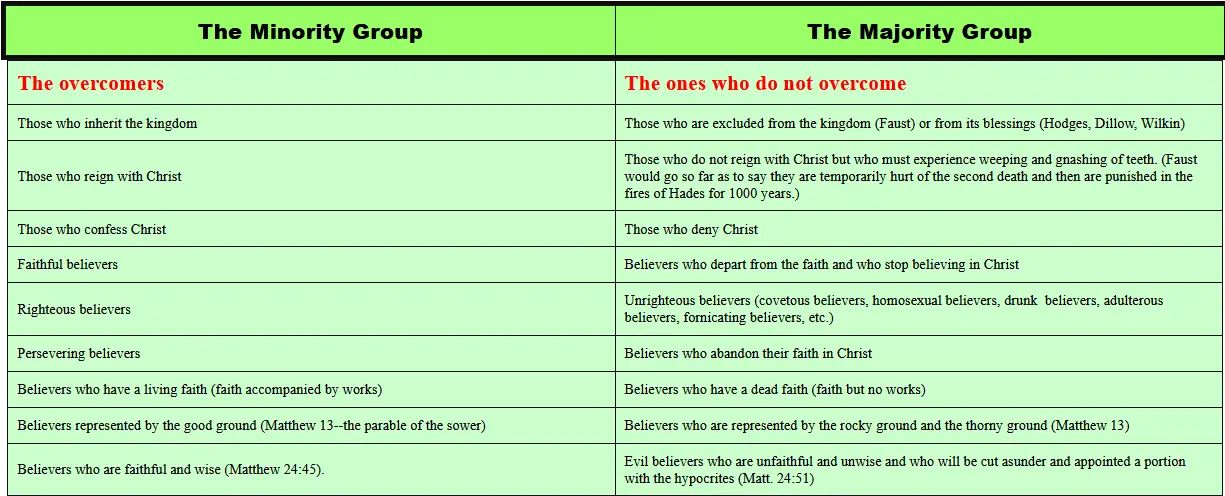
Please note: Not every description given in the right hand column necessarily applies to each and every believer who fails to inherit the kingdom, according to the teaching of Hodges and Dillow. For example, a person may not abandon his faith in Christ, but he may be guilty of serious immorality. He may not stop believing, but he may be totally caught up in the things of the world. He may not deny Christ, but he may be a practicing homosexual. Etc. Another person may live a very moral life in every way, but be guilty of denying Christ and abandoning the faith. According to their theology, there are various ways that a saved person can disqualify himself from being an overcomer.
Having totally divided the body of Christ in this way, they then assign totally different destinies to these two groups, with the majority group suffering punishment or exclusion during the thousand year kingdom. They claim that the “non-overcomers” will not reign with Christ and will be cast into outer darkness. Let us now examine this theory under the searchlight of God’s Word.
The Overcomer of Revelation Chapters 2 and 3
“To him that overcometh will I give to eat of the tree of life, which is in the midst of the paradise of God….He that overcometh shall not be hurt of the second death….To him that overcometh will I give to eat of the hidden manna, and will give him a white stone, and in the stone a new name written, which no man knoweth saving he that receiveth it….And he that overcometh, and keepeth My works unto the end, to him will I give power over the nations: And he shall rule them with a rod of iron….He that overcometh, the same shall be clothed in white raiment; and I will not blot out his name out of the book of life, but I will confess his name before My Father, and before His angels….Him that overcometh will I make a pillar in the temple of My God, and he shall go no more out: and I will write upon him the name of My God, and the name of the city of My God, which is new Jerusalem, which cometh down out of heaven from My God: and I will write upon him My new name….To him that overcometh will I grant to sit with Me in My throne, even as I also overcame, and am set down with My Father in His throne” (Revelation 2:7,11,17,26-27; 3:5,12,21).
Who is the Overcomer?
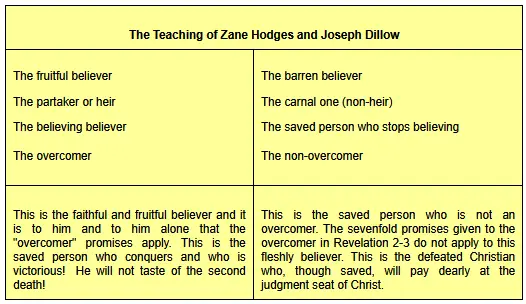
Hodges and Dillow and the other men mentioned above teach that a large number of saved people will not qualify as overcomers. They also teach that being an overcomer is something that must be earned and achieved by faithful living.
We all recognize that a true believer can fall into sin, can exhibit carnality, can walk in the flesh, can backslide, can bring shame to the cause of Christ, etc. Certainly such a walk would not be described as victorious (the term “overcomer” comes from the Greek term “victory.” It is the Greek word “Nike”–compare the famous sneaker/sportswear company). True believers can and do experience defeat at certain times in their Christian walk, and everyone of us has experienced such times and has learned from them. The Apostle Peter would certainly not be described as victorious when he denied the Lord three times, but his lapse of faith was not permanent and later he boldly confessed Christ before thousands on the day of Pentecost. If you were to take a snapshot of Peter denying his Lord, you might conclude that Peter was a defeated Christian. If you were to take a video of Peter’s entire Christian life, you would conclude that Peter was an overcomer! His denial of Christ was an aberration, not the norm.
How does the New Testament define and identify the overcomer?
Who is the overcomer? This is answered in 1 John 5:4,5— “For whatsoever is born of God overcometh the world: and this is the victory that overcometh the world, even our faith. Who is he that overcometh the world, but he that believeth that Jesus is the Son of God?” According to these verses every born again believer is an overcomer. Why is this true? It is because the Lord Jesus is THE OVERCOMER and we are trusting and resting in His perfect victory (compare John 16:33). How can a person be joined to Jesus Christ and be in perfect union with Him, and not be a victor? Please note that this is the only place in the New Testament where the question, “Who is he that overcometh?” is asked and answered. Also note that the answer was given by the Apostle John, the same man who was the human penman for Revelation chapters 2-3.
Hodges goes so far as to say that it is “totally illicit” (illegal!) to appeal to 1 John 5:4-5 in order to understand who the “overcomer” really is (Grace in Eclipse, p.108). Is it illegal to let God’s Word explain its own terms? Is it illegal to compare Scripture with Scripture? Is it illegal to allow the Apostle John to define the word “overcomer”? Hodges is concerned because the Apostle John’s definition of an “overcomer” in 1 John 5:4-5 is not in agreement with his own definition of an overcomer. For my part, I choose to agree with the Apostle John.
1 John 4:4 also teaches that every believer is an overcomer. “Ye are of God, little children, and have overcome them: because greater is he that is in you, than he that is in the world.” This victory is something that every child of God partakes in. It is not based upon what the believer was earned or achieved, but it is based on WHO indwells the believer!
Revelation 21:7 refers to every saved person: “He that overcometh shall inherit all things.” This passage distinguishes between only two broad classes, the saved (see verses 3-5) and the unsaved (verse 8). The contrast is not between believers who overcome and believers who do not overcome. The contrast is between believers who overcome (verse 7) and the unsaved who are in the lake of fire (verse 8). No mention is made of a supposed third group made up of saved people who are defeated failures (non-overcomers). There are only two groups, and there is a heaven and hell difference between the two. William Newell, commenting on this passage: “Be it noted, the only two classes seen in this final eternal order are those who overcome, and those cast into the lake of fire. The ‘overcomers,’ thus, are shown to be all God’s true children” (Revelation, p. 339). It is unthinkable that Chapter 21 of the book of Revelation would use the term “overcomer” differently than the way the term is used in Revelation chapters 2 and 3. If “he that overcometh” in Revelation 21:7 refers to all of the saved, then we should expect it to mean the same thing in chapters 2 and 3.
Consider one of the promises given to the overcomer as found in Revelation 2:11— “He that overcometh shall not be hurt of the second death.” This implies that the non-overcomer will be hurt of the second death. If the non-overcomer is a saved person (carnal, etc.), then does this mean that the carnal believer will be hurt of the second death which is the lake of fire (compare Rev. 20:14-15; 21:8)? It is obvious that every saved person, regardless of his degree or level of faithfulness in this life, can claim the promise that he will not be hurt of the second death.
Romans 8:37 is an excellent “overcomer” verse because it teaches that every believer is “more than an overcomer,” indeed he is a “super-overcomer” (literal rendering of Greek). The “we” of verse 37 refers to every true believer (those who have been predestinated, called, justified, glorified–v.29-30). “We are (v.37)”–right now this is true! “In all these things”-in the midst of all the difficulties we triumph! “More than conquerors” = hyper-conquerors, super-conquerors, super-victors, super-overcomers. It refers to one who gains a surpassing or an overwhelming victory, the one who wins a most glorious victory. It is the Greek word hupernikao (from “huper”–compare the English words “hyper” and “super” and the verb “nikao”–to overcome, to have the victory (same word used for overcomers in Revelation 2-3). We are not just overcomers, we are more than overcomers! We are not just victors, we are more than victors! How could anyone say, in light of this, that some believers are not overcomers? No believer is less than an overcomer, all believers are “more than overcomers”! Ours is an overwhelming victory! Why are we super-overcomers? It is “through Him who loved us” and it has nothing to do with how well we have lived our Christian life. It is not something we earn, but it is something that every believer already has because of Jesus Christ.
Another place in the New Testament where the term “victory” is used is 1 Corinthians 15:57–“But thanks be to God, which giveth us the victory through our Lord Jesus Christ.” It is obvious from this passage that all believers have been given the victory through our Lord Jesus Christ, not just a few exceptional believers who earned the victory by their good works and steadfastness. It was Christ who earned the victory, not us. We just share in the great victory that He accomplished. As the hymn says, we have “VICTORY THROUGH GRACE,” not through our own personal merit or achievement.
John 16:33 is an encouragement to the heart of every true believer. In the world we have tribulation (trouble, distress, affliction, pressure), but in Christ we have peace and victory. “I have overcome the world” and we stand victorious in His victory. We are “IN HIM” and we share in his victory. We overcome because He overcame! Standing on the finished work of Jesus Christ, how can we be defeated? How can we be losers? The victory is HIS, and are we not united to Him?
There is not one passage in the New Testament where the term “overcomer” or “victor” is used (or any of its related terms) that even gives the slightest hint that there are some believers who fail to measure up to the status of “overcomers.” No, the passages are unanimous in teaching that because of Jesus Christ, we ARE overcomers! It is not something we earn or achieve by our faithfulness; it is something that Christ accomplished for us and is ours because of our union with Him.
Revelation Chapters 2-3
“To him that overcometh will I give to eat of the tree of life, which is in the midst of the paradise of God” (Rev. 2:7).
The only other mention of the “tree of life” in the book of Revelation is found in chapter 22. See verses 2, 14, 19 (in verse 19 the Greek text says, “tree of life” not “book of life”). These verses indicate that those who dwell in the eternal city (all believers) have the right to partake of the tree of life in contrast to the wicked unbelievers who will not partake (Rev. 22:15, 18-19). Will there be multitudes of saved people (“non-overcomers”) who will not eat of the tree of life? Such is unthinkable!
“He that overcometh shall not be hurt of the second death” (Rev. 2:11).
Consider the following: 1) Revelation 2:11 implies that non-overcomers will be hurt of the second death; 2) The second death is equivalent to the lake of fire (Rev. 20:14; 21:8); 3) The only ones who will be cast into the lake of fire are those whose names are not found written in the book of life (Rev. 20:15); 4) All of the saved have their names written in the book of life (compare Luke 10:20); 5) The lake of fire is for wicked unbelievers (Rev. 21:8); 6) Since Revelation 2:11 implies that non-overcomers will be hurt by the second death and since the Bible teaches that believers will not be hurt by the second death (lake of fire), then we are forced to conclude that the non-overcomers must be wicked unbelievers, not a special class of believers who have somehow failed to measure up.
The view which says that the overcomers are a special elite class of victorious Christians does not fit with Revelation 2:11. Even the most carnal believer will not be hurt of the second death. God Word is clear on this (John 5:24; John 11:25-26; Romans 8:1; etc.). The second death is the destiny only of those who are unbelieving (Rev. 21:8), for those whose names are not found written in the book of life (Rev. 20:15). If the Hodges/Dillow/Wilkin/Missler view is correct, then Revelation 2:11 makes no sense. Why would the overcoming Christian be promised something that is enjoyed by even the most fleshly believer? What kind of reward is that? What if a college professor makes this promise: “If you get a 90 or above on my final exam, not one of you will be sent to prison.” This promise is totally meaningless if the majority of students who do poorly on the exam are likewise exempt from prison. If the non-overcomer never need fear the second death, then what incentive is there for the believer to achieve a victorious life? After all is said and done, both groups of believers end up unhurt by the lake of fire. It makes no sense. However, if we correctly understand the “overcomer” to be the one who “believeth that Jesus is the Son of God” (1 John 5:5), then Revelation 2:11 makes good sense. It implies that the non-overcomer (the unbeliever) will be hurt by the second death, and this is certainly what will happen to every unbeliever. Every believer can rejoice that in Christ, our great Overcomer (John 16:33), we have complete salvation, including full exemption from the second death, which is the lake of fire. Actually to say all believers are overcomers is an understatement. All believers, according to Romans 8:37, are “super overcomers” (“more than conquerors”).
“He that overcometh, the same shall be clothed in white raiment; and I will not blot out his name out of the book of life, but I will confess his name before My Father, and before His angels” (Rev. 3:5).
This is a wonderful promise of eternal security. Those who belong to Christ will never have their names blotted out of the book of life. Their names permanently etched in that book. They cannot be lost. This promise holds true for the Apostle John, for the Apostle Paul and even for the most carnal church-age believer who has ever lived! If God were to blot out his name from that book, then this would mean that he must be cast into the lake of fire (Rev. 20:15). Perish the thought!
The last part of Revelation 3:5 reminds us of two statements made by our Lord: “Whosoever therefore shall confess me before men, him will I confess also before my Father which is in heaven. But whosoever shall deny me before men, him will I also deny before my Father which is in heaven” (Matthew 10:32-33). “Also I say unto you, Whosoever shall confess me before men, him shall the Son of man also confess before the angels of God: But he that denieth me before men shall be denied before the angels of God” (Luke 12:8-9).
The person who confesses the Lord before men says this: “I want you to know that Jesus Christ is my Saviour. I belong to Him.” Jesus Christ will confess this person before His Father and before the angels: “I want you to know that this believer is Mine. He belongs to Me!”
When Christ denies a person before the Father and before the angels, what does this mean? The person who denies the Lord before men says this: “I do not know Jesus Christ. He is not my Saviour.” Jesus Christ will deny this person before His Father and before the angels: “I do not have a saving relationship with this person. He does not belong to me.” Compare the words of Jesus in Matthew 7:23–“And then I I will profess unto them, I never knew you; depart from Me, ye that work iniquity.” The ones denied by Christ are unsaved. For Hodges and Wilkin and Dillow to claim that the ones denied by Christ are saved people is quite a stretch
