
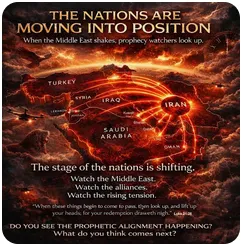
Jesus said in Luke 21:28, “And when these things begin to come to pass, then look up, and lift up your heads; for your redemption draweth nigh.” Jesus did not tell us to be terrified; He told us to look up. Bible prophecy was not given to make believers afraid. It was given to make believers alert. It reminds us that history is not random, nations are not moving outside the knowledge of God, armies are not gathering beyond His control, and political leaders are not changing the future in ways God never expected. God already knows the end. Isaiah 46:9–10 records the Lord saying, “I am God, and there is none else; I am God, and there is none like me,” and then declaring that He is “declaring the end from the beginning, and from ancient times the things that are not yet done.” God does not guess about tomorrow. He declared the end from the beginning. That should give us both urgency and confidence: urgency because the world is not standing still, and confidence because God has not lost control.
Proverbs 21:1 says, “The king’s heart is in the hand of the LORD, as the rivers of water: he turneth it whithersoever he will.” Presidents may make decisions, kings may sign agreements, generals may build armies, and diplomats may create alliances, but God remains above them all. Psalm 83 presents another sobering picture of hostility toward Israel. Israel’s enemies say, “Come, and let us cut them off from being a nation; that the name of Israel may be no more in remembrance” (Psalm 83:4). Whatever interpretive questions Christians may have about the exact prophetic timing of this Psalm, the spirit of hostility described there is impossible to miss. Israel’s enemies do not merely disagree with Israel; some want Israel gone. That desire has appeared repeatedly in the modern world, and yet Israel remains. That fact alone should remind us that history is not controlled merely by armies, governments, or international organizations. God made promises, and those promises matter.
Psalm 121:4 says, “Behold, he that keepeth Israel shall neither slumber nor sleep.” God has not forgotten Israel, Jerusalem, or His covenant promises. The world may debate Israel’s right to exist, but God does not. The nations may try to decide Jerusalem’s future, but God has already declared His purposes. The world may believe it controls the final outcome, but Scripture says otherwise. This is why the church should watch Jerusalem carefully, not with political obsession, but with biblical understanding. Jerusalem is not important merely because politicians say it is important. Jerusalem is important because God says it is important. The prophets spoke of it, Jesus spoke of it, and Scripture places it at the center of major events in the latter days.
Zechariah 12:3 goes even further when it says, “And in that day will I make Jerusalem a burdensome stone for all people.” Jerusalem would become a burden the nations could not solve, and they would continually involve themselves with it. That is exactly what makes the modern attention on Jerusalem so remarkable. From a purely political point of view, the amount of attention given to this small city seems far out of proportion to its size, but from a biblical perspective, it makes perfect sense. This is also why the formation of new military relationships in the Muslim world deserves our attention. The issue is not simply whether Turkey, Saudi Arabia, Pakistan, Egypt, or any other country plans to attack Israel today. The issue is what kind of world is being built around Israel. Are military relationships becoming stronger? Are nations becoming more willing to cooperate? Is Israel increasingly becoming a common point of hostility? Is Jerusalem becoming more difficult for the world to ignore? Those are the kinds of developments students of Bible prophecy should watch.
We may not know how quickly events will move. We may not know which present-day alliance will survive. We may not know which leaders will be in power five or ten years from now, and we may not know what tomorrow’s crisis will be. But we do know what Scripture says. Jerusalem will be a burdensome stone, nations will gather, Israel will remain at the center of prophetic events, and God will remain in control. Psalm 33:10–11 says, “The LORD bringeth the counsel of the heathen to nought: he maketh the devices of the people of none effect. The counsel of the LORD standeth for ever, the thoughts of his heart to all generations.” The counsel of governments changes, but the counsel of God stands forever. Military alliances rise and fall, but the Word of God remains. Kings come and go, but God remains on the throne.
That is why we do not watch with fear. We watch with expectation, discernment, and an open Bible. The most important part of this new military relationship may not be what it is today, but what it helps create tomorrow. Military coalitions are built slowly through treaties, defense agreements, shared enemies, intelligence networks, joint planning, and new members. Over time, those pieces can form something much larger than anyone expected at the beginning. We do not yet know whether this alliance will become that kind of structure. It may remain limited, it may weaken, it may disappear, or it may grow into something far more powerful. But the greater truth remains unchanged: the world around Israel is changing, alliances are shifting, military cooperation is increasing, old enemies are becoming partners, former partners can become rivals, and the balance of power in the Middle East is being rearranged. In the middle of it all sits Israel, exactly where Scripture told us Israel would be.
So this is not the time for the church to sleep. It is not the time to ignore prophecy because it makes people uncomfortable, and it is not the time to treat Israel and Jerusalem as though they were merely ordinary political issues. It is time to watch, to understand the hour, and to recognize that the world described by the prophets is becoming easier to imagine with every passing year. We watch Turkey, Saudi Arabia, Pakistan, Egypt, Iran, Israel, and Jerusalem, but above all, we watch the Word of God. The nations may believe they are moving history forward according to their own plans, but God has already declared the end from the beginning. The alliances being formed today may become far more important tomorrow. Jerusalem may become an even greater source of international conflict, nations may gather, governments may rage, and armies may move, but none of it will catch God by surprise. The final chapter has already been written. The nations are moving, the alliances are forming, the world is changing, Jerusalem remains a burdensome stone, and the Bible is still speaking.
