
Gen 6:6 And it repented the Lord that he had made man on the earth, and it grieved him at his heart. 7 And the Lord said, I will destroy man whom I have created from the face of the earth; both man, and beast, and the creeping thing, and the fowls of the air; for it repenteth me that I have made them.
Does God change his mind (Genesis 6:7; Exodus 32:14; 1 Samuel 15:10-11, 35), or does he not change his mind (1 Samuel 15:29)?
1 Sam 15:10 Then came the word of the Lord unto Samuel, saying, 11 It repenteth me that I have set up Saul to be king: for he is turned back from following me, and hath not performed my commandments. And it grieved Samuel; and he cried unto the Lord all night.
1 Sam 15:35 And Samuel came no more to see Saul until the day of his death: nevertheless Samuel mourned for Saul: and the Lord repented that he had made Saul king over Israel.
1 Sam 15:28 And Samuel said unto him, The Lord hath rent the kingdom of Israel from thee this day, and hath given it to a neighbour of thine, that is better than thou. 29 And also the Strength of Israel will not lie nor repent: for he is not a man, that he should repent.
God knew that Saul would fail in his duty as King of Israel. Nevertheless, God allowed Saul to be king and used him greatly to do His will. Saul was highly effective as leader of Israel, in stirring his people to have courage and take pride in their nation, and in coping with Israel’s enemies during times of war.
However, God made it clear long before this time that he would establish the kings that would reign over Israel, from the tribe of Judah.
Gen 49:10 The sceptre shall not depart from Judah, nor a lawgiver from between his feet, until Shiloh come; and unto him shall the gathering of the people be.
Saul was from the tribe of Benjamin. Therefore there was no doubt that Saul or his descendants were not God’s permanent choice to sit on the throne of Israel. His successor David, however, was from the tribe of Judah, and his line was to continue. Therefore God, who knows all things, did not ‘change his mind’ about Saul, for he knew Saul would turn away from Him and that the throne would be given to another.
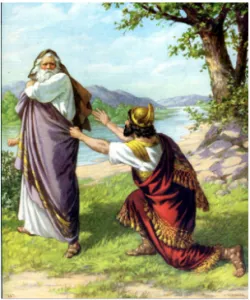
As a result of Saul’s disobedience, pain was caused to God and to the people of Israel. But also, God had it in His plan from the beginning that Saul’s family, though not being from the tribe of Judah, would not stay on the throne. Therefore when Saul begs the prophet Samuel in verses 24 to 25 to be put right with God and not be dethroned, Samuel replies that God has said it will be this way – He is not going to change His mind. It was spoken that it would be this way hundreds of years before Saul was king.
1 Sam 15:24 And Saul said unto Samuel, I have sinned: for I have transgressed the commandment of the Lord, and thy words: because I feared the people, and obeyed their voice. 25 Now therefore, I pray thee, pardon my sin, and turn again with me, that I may worship the Lord.
1 Sam 15:28 And Samuel said unto him, The Lord hath rent the kingdom of Israel from thee this day, and hath given it to a neighbour of thine, that is better than thou. 29 And also the Strength of Israel will not lie nor repent: for he is not a man, that he should repent.
Another apparent “contradiction” of the Scripture of which a great deal is made and which has puzzled a great many believers follows.
We read in Malachi 3:6, “For I am the LORD, I change not”; in James 1:17, “Every good gift and every perfect gift is from above, and cometh down from the Father of lights, with whom is no variableness, neither shadow of turning”; and in 1 Samuel 15:29, “And also the Strength of Israel will not lie nor repent: for he is not a man, that he should repent.”
[Num 23:19 God is not a man, that he should lie; neither the son of man, that he should repent: hath he said, and shall he not do it? or hath he spoken, and shall he not make it good?]
But in apparently flat contradiction of these we read –
[Gen 6:7 And the Lord said, I will destroy man whom I have created from the face of the earth; both man, and beast, and the creeping thing, and the fowls of the air; for it repenteth me that I have made them. And, in
Ex 32:14 And the Lord repented of the evil which he thought to do unto his people. And, in]
Jonah 3:10 , “And God saw their works, that they turned from their evil way; and God repented of the evil, that he had said that he would do unto them; and he did it not”; and in Genesis 6:6, “And it repented the LORD that he had made man on the earth, and it grieved him at his heart.” Here it not only says “it repented God,” but “it grieved him at his heart.” Now this appears like a flat contradiction. What is the explanation?
What the first set of passages says is absolutely true, that God is absolutely unchangeable. He is “the same yesterday, and today, and for ever” (Hebrews 13:8 ). But the second class of passages is also true, for if God does remain the same in character, infinitely hating sin and absolutely unchangeable in His purpose to visit sin with judgment, then if any city or any person changes in attitude toward sin, God must necessarily change in His attitude toward that person or city. If God remains the same, if His attitude toward sin and righteousness is unchanging, then His dealings with men must change as they turn from sin to repentance. His character remains ever the same, but His dealings with men change as [men] change from [being full of sin to being full of righteousness; whereas, God has a dichotomy with His character: an unchanging hatred of sin, and an unchanging love of righteousness.]
We may illustrate this by the direction of a railway station that remains stationary, relative to a train that moves along the track in front of the station. When the train begins to move it is to the east of the station, but as the train moves westward it is soon west of the station. The only way in which the station could maintain the same direction relative to the moving train would be by moving as the train moves. If the station is unchangeable in its position, its direction relative to the train must change as the train moves. So it is with God’s attitude toward man. If God remains unchangeable in His character, His purpose and His position, then as man moves from sin to righteousness, God’s attitude relative to that man must change. The very fact that God does not repent (change His mind), that He remains always the same in His attitude toward sin, makes it necessary that God should repent in His conduct (change His dealings) with men as they turn from sin to righteousness.
[Webster’s 1828 Dictionary defines repent/repentent/repentance, in part, as: “Sorrowful for past conduct or words. Sorrowful for sin. Sorrowful for anything done or said. Grieving for what is past.” Does this help in resolving this supposed contradiction? Key words here might be ‘sorrow’ and ‘grieve’. We, of course, know that God does not and can not sin. Note that nowhere in Webster’s definitions of ‘repent’ and its variations does it state anything like “to change one’s mind”. Thus, when God repents of something, it deals with His sorrow/grief towards it or them.]
As to Jehovah’s repenting of having made man on the earth and its grieving Him at His heart, this too is necessitated by the unchanging attitude of God toward sin. If God does not repent (change His mind about sin, His attitude toward sin), and if man’s wickedness becomes great, then God’s unrepenting, unchanging hatred of sin necessitates that the man whom He has created, who has fallen into sin so great and so abhorrent to Himself, should become the object of great grief to Him, and that He should turn from His creative dealings with man to His destroying dealings with man. This was necessitated by man’s sin. An unchangeably holy God must destroy man who has become so hopelessly sunken in sin. The only condition upon which He could spare him would be that God Himself change from the holiness of His character as it was when He created him to become an unholy God.
So again we see that what appears at the first glimpse like a flat contradiction is really no contradiction at all but an entire agreement in fact and thought between passages that seem to contradict in words.
Though I don’t fully understand God’s repentance, I do understand the following things about His repentance:
1. God’s repentance is not like man’s repentance. Man must repent because he is a sinner and he must repent of his sin and change his mind about how he is living. God’s repentance has to do with changing His mind about how He acts toward men, and His repentance is based on man’s actions, not His own actions.
2. God’s repentance shows that God has great feelings and that He is affected deeply by man’s actions. He is not an unfeeling Robot God. God knows all things. His understanding is infinite (Psa. 147:5; 1 John 3:20). He knows the beginning from the end (Isa. 46:10). Yet God can also be grieved by man’s sin (Gen. 6:6; Psa. 95:10; Eph. 4:30. Christ, God manifest in the flesh, wept over Jerusalem because of her unrepentance (Luke 19:41). He was sad because Israel would not believe (Matthew 23:37).
3. God’s promises and eternal plans are unchangeable (Rom. 11:29; Heb. 6:17-18; Psa. 110:4). He will not and cannot repent of these. This is what Numbers 23:19 is saying. God cannot repent of His eternal plan for Israel and His covenant promises to Israel. Likewise, He cannot repent of any of His promises, including the promise to give eternal life to those who believe on Jesus. For this reason, all of God’s promises are yea and amen; they are absolutely sure (2 Cor. 1:20).
4. The context of Genesis 6:6 explains God’s repentance in that situation. God repented in the sense that He was grieved and hurt by man’s sin. That is explained in the verse itself. The next verses explain that God didn’t repent of His original plan of making man. He repented only insofar as He determined to destroy that generation of man. God’s original plan for man as described in Ephesians 1:9-10 was not repented of and continued to be fulfilled through Noah and his sons.
Approximately 31 places in Scripture mention repentance in connection with God, most of them saying that He repented or promised to repent if man would change (Gen. 6:6, 7; Ex. 32:14; Jud. 2:18; 1 Sam. 15:11, 35; 2 Sam. 24:16; 1 Ch. 21:15; Psalm 90:13; 106:45; Jer. 18:8; 26:3, 13,19; 42:10; Joel 2:13, 14; Am. 7:3, 6; Jonah 3:9, 10; Zech. 8:14). Such statements present at least three problems to the Bible believer: (1) How could God repent if He is unchangeable, as Malachi 3:6 teaches? (2) There are apparent contradictions between the aforementioned Scriptures and others which teach that God does not repent (Nu. 23:19). (3) God’s repentance would have to be different from man’s, which involves sorrow for sin.
When Scripture says that God repented, it shows that He is not an unfeeling machine. He has emotions (such as wrath—Heb. 3:11) and responds to man’s actions, showing approval or disapproval. A.H. Strong, in his classic book, Systematic Theology, said, ‘God’s unchanging holiness requires him to treat the wicked differently from the righteous. When the righteous become wicked, his treatment of them must change.
A great truth to remember in all this is that God is unchangeable in His eternal plan. The following Scriptures show that, before creation, God established a plan for all the ages (Eph. 1:9, 11; Titus. 1:2; Rev. 13:8).
Eph 1:9 Having made known unto us the mystery of his will, according to his good pleasure which he hath purposed in himself: 10 That in the dispensation of the fulness of times he might gather together in one all things in Christ, both which are in heaven, and which are on earth; even in him:
Within this plan, God decided to make certain changes. To quote from A.H. Strong again, “God’s repentance describes ‘executions, in time, of purposes eternally existing in the mind of God. Immutability must not be confounded with immobility.’”
What we have done is to interpret one Scripture by another. Some Scriptures state basic principles of truth by which all others must be understood. The statement of Eph. 1:11, that God ‘worketh all things after the counsel of His own will,’ must control our understanding of other verses which describe only one of those things. Thus, each individual act of God must be considered within the overall context of Who and What He is.
In Num. 23:19, ‘God is not a man that he should lie; neither the son of man, that he should repent,’ Balaam was not describing God generally, but specifically, in relation to His plan for Israel. That is, Balaam was not saying that God would never repent of anything, but that He would not repent of His promises to Israel.
In 1 Sam. 15:29, ‘And also the Strength of Israel will not lie nor repent,’ Samuel was not saying that God would never repent of anything, but was referring to God’s statement that He would remove Saul from being king (v. 11). God would not repent of that promise.
In Psalm 110:4, ‘the Lord hath sworn, and will not repent, Thou art a priest for ever after the order of Melchizedek,’ God is speaking of His promise to Christ.
(Bruce Lackey, Repentance Is More Than a Change of Mind).
From the Bible, we know that God, in His holiness and righteousness, must punish sin and that His decreed punishment for sin is death (Genesis 2:15–17; Romans 6:23). Yet we also know that God is full of grace and abounding in mercy, forgiving the repentant of their sins (Exodus 34:6–7). The balance between these two aspects of God’s nature may be best summed up in this passage from Jeremiah:
Jer 18:7 At what instant I shall speak concerning a nation, and concerning a kingdom, to pluck up, and to pull down, and to destroy it; 8 If that nation, against whom I have pronounced, turn from their evil, I will repent of the evil that I thought to do unto them. 9 And at what instant I shall speak concerning a nation, and concerning a kingdom, to build and to plant it; 10 If it do evil in my sight, that it obey not my voice, then I will repent of the good, wherewith I said I would benefit them.
Gen 6:6 And it repented the Lord that he had made man on the earth, and it grieved him at his heart.
1 Sam 15:11 It repenteth me that I have set up Saul to be king:…
Passages such as the two above simply show the emotional reactions God has to sin in those He created in His image. They aren’t expressions of, “I didn’t do that right the first time; guess I better figure out something else to do.” Instead, God is grieving over disobedience and wickedness: a response that we should all have to sin. Again, this doesn’t indicate a change in His nature or character; in fact, it is His holy nature that demands this response of grief.
God does not change. However, He can change how He chooses to respond to an individual or nation’s actions
(Stacia McKeever of AIG)
