
Gen 3:14 And the Lord God said unto the serpent, Because thou hast done this, thou art cursed above all cattle, and above every beast of the field; upon thy belly shalt thou go, and dust shalt thou eat all the days of thy life: 15 And I will put enmity between thee and the woman, and between thy seed and her seed; it shall bruise thy head, and thou shalt bruise his heel.
Some people try to discredit Genesis by saying snakes don’t eat dust [(or dirt)], as Genesis 3:14 claims and, therefore, the Bible is in error. [One point to ponder is that] we can’t know for sure that the serpent referred to in Genesis 1 really was the same as a snake today.
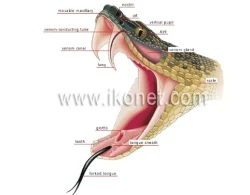
Many have responded to this charge by pointing out that a snake has an organ located in the front of the roof of its mouth that functions as a chemical receptor. The Jacobson’s organ helps the snake smell. As a snake’s forked tongue darts out to sense its surroundings, it, at least occasionally, licks the ground or picks up dust particles. Once the snake pulls in its tongue, it inserts the tips of its forked tongue into the two openings of the Jacobson’s organ, where the particles are identified and analyzed. The snake’s brain can “read” the smells and tastes from its tongue. So, in a way, snakes really do eat dust.
Notice that the serpent’s curse included crawling on its belly, eating dust, bruising the heel of the woman’s Seed, and the Seed bruising the head of the serpent. Most theologians have recognized verse 15 as the protoevangelium (“first gospel”). God, here, prophesies the coming of the Messiah, Jesus, the one who would die for our sins and rise again, defeating Satan. The bruising of the heel and the bruising of the head are obviously symbolic language, pointing to a greater reality. Recognizing this in no way violates the historical genre of Genesis: the symbolic language is still couched within a largely literal framework.
So, did God curse the animal or Satan? It appears he cursed both of them. Throughout the Scriptures, God commonly speaks to the vessel and then to Satan.
Here are a few examples:
In Ezekiel 27–28 the Word of the Lord was said to Tyre itself (Ezekiel 27:2), then to the ruler of Tyre (Ezekiel 28:2), and then a lament beginning in Ezekiel 28:11 to the “King of Tyre.” This one was specifically directed to the one influencing the King of Tyre—Satan. Jesus rebuked Peter and then spoke to Satan when he influenced Peter in Mark 8:33.
This concept of speaking directly to Satan while he is influencing someone is nothing uncommon. So, there is no stretch to understand that the Lord is speaking to the serpent and Satan in Genesis 3. Genesis 3:14 is said to the serpent, and then Genesis 3:15 is said to Satan, who is influencing the serpent.
The curse pronounced upon the serpent of “eating the dust” is a result of it now crawling on its belly in the dust. It used to be like one of the “cattle” and “beast of the field” (Genesis 3:1, (14)), but now will crawl on its belly and eat dirt. More importantly, this imagery of eating dust is symbolic of a creature low, despicable, abhorrent, and degraded. In Micah 7:16–17, God prophesies of a time when the nations will come crawling to Him:
16 The nations shall see and be confounded at all their might: they shall lay their hand upon their mouth, their ears shall be deaf. 17 They shall lick the dust like a serpent, they shall move out of their holes like worms of the earth: they shall be afraid of the Lord our God, and shall fear because of thee.
A proper understanding of the context (literary, historical, and theological) helps us understand what God meant when he cursed the serpent. There is no contradiction here, but rather a wonderful promise of victory by a risen Savior.
God cursed the serpent and said that serpent will face humiliation (eat dust). It was used as a phrase and not as a diet. In my part of the world and in Middle East, if you have to curse someone you simply use these words, Dust in your mouth. Does it mean that the person will have dust in his/her mouth? It is a phrase of humiliation and does not correspond to any dietry habits.
