
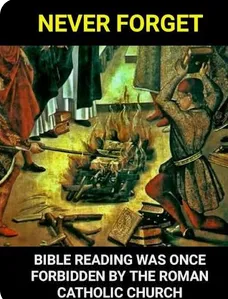
For 600 years the Roman Catholic Church attempted to keep the Bible out of the hands of the people.
– The Council of Toulouse, 1229, decreed that “the laymen” (non-priests) could not possess the books of the Old and New Testament “in the vulgar tongue.” The declaration of this official council was repeatedly cited by subsequent popes and councils.
– The Council of Trent, in 1546, claimed that the indiscriminate distribution of the Scriptures caused more evil than good and forbade the people to possess the Bible without a written license, which was almost never given. Booksellers were forbidden to sell any Bibles except to people who possessed a license.
– Wherever Rome held power, the people did not have access to the Bible. The Roman Catholic Church did not produce a Bible in English until 1582, fully two centuries after John Wycliffe made the first English Bible, and more than a half century after William Tyndale made his masterpiece for the English-speaking world. In South and Central America, the first Bible was not printed by the Catholic Church until 1831, 400 years after the birth of printing; and those Bibles were priced at from $25 to $130, far out of reach of most people (Melancthon Jacobus, Roman Catholic and Protestant Bibles Compared, 1905, p. 235). While visiting Rome in 1838, Protestant minister J.A. Clark said, “The Bible in Rome is a strange and rare book. The only edition of it authorized to be sold here is in fifteen large volumes which are filled with Popish commentaries. Of course none but the rich can purchase a copy of the sacred Scriptures. Indeed very few of the common people know what we mean by the Bible” (Charles Elliott, Delineation of Roman Catholicism, 1851, p. 23). The situation had not changed by 1892. William Seymour, an Anglican minister, visited every bookstore in Rome and did not find a single copy of the Bible for sale in the Italian language (H. Hobart Seymour, Mornings among the Jesuits at Rome, 1892, pp. 132-135). Writing from France in 1824, Noah Webster told his daughter Rebecca, “The Catholics generally have no Bibles” (Webster’s Papers). In 1907, there were no Bibles in Catholic Ireland in nine-tenths of the cities, towns, and villages (Alexander Robertson, The Papal Conquest, 1909, pp. 166-167).
– Huge quantities of Scriptures in English, Romaunt, German, Italian, French, Spanish, and other languages, were confiscated by Rome and destroyed from the 13th to the 19th centuries.
– Bible translators were imprisoned and burned. John Wycliffe’s bones were exhumed and burned, and William Tyndale and John Rogers were burned at the stake.
– Throughout the 19th century, the popes condemned the Bible Societies. In 1816, Pope Pius VIII condemned the Bible Society of Poland. He called Bible distribution “a most crafty device, by which the very foundations of religion are undermined … a defilement of the faith, eminently dangerous to souls.” He said that the distribution of Bibles “produces more harm than benefit” and put all Bibles printed by the “heretic” Bible Societies on the Index of Prohibited Books. Similar proclamations were made by Pope Leo XII (1824), Pope Gregory XVI (1836 and 1844), Pope Pius IX (1846), and Pope Leo XIII (1887). Beginning in 1870, a papal law required that copies of the Bible found in the possession of visitors to the Vatican City be confiscated (Philip Schaff, History of the Christian Church, VI, p. 727).
