
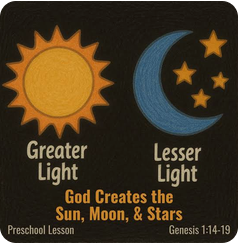
This objection is a favorite classic because whether you interpret the Creation account figuratively or literally, the issue is still there: how could God create light on Day 1, yet not make the stars, Sun, and Moon until Day 4 (Gen. 1:14-19)?
It becomes even more poignant due to the fact that there’s a day and night from the beginning, but no Sun or Moon until Day 4.
I’ll answer the second point first: the definition of a day is one revolution of the Earth around its axis (c.23 hours and 56 min), not ~12 hours of daylight and darkness. Otherwise areas near the poles which experience half a year of constant daylight/darkness have what? One day a year? Clearly not. Moreover, it’s clearly a reference point with respect to God’s order of creation and man’s chronology. Hence why we can talk about how many days it takes for Mars to make one revolution around the Sun in terms of Earth days and not Martian days.
As for the first, more serious question, I’ll draw a parallel from Tahitian customs. When Europeans first came there in the 18th century, they recorded a grand ceremony that took place on some occasions by specific entertainers called arioi – they danced and did all sorts of routines including comedy miming. It took place generally at night, on the grounds of a huge special-built house, illuminated with fires and such called rehu arui (night daylight). [Wahlroos, Sven. Mutiny and Romance in the South Seas, p.213] Clearly God can create light without stars or the Sun or the Moon, which is especially obvious as the Moon doesn’t have light of its own.
The problem isn’t that one can imagine this, but the fact that Gen. 1:5 says that God called the light “day” and the dark “night”, which is strange at the very least if there’s no Sun (no need for a Moon) until three days later. However, this part is clearly descriptive because, for example, Gen. 1:4 says God divided light from darkness, which makes no sense if taken literally (light is by definition different from darkness). So the intent is meant to be understood that God was the one who ordained the fact that days exist and that nights are dark. This is further supported by the fact that God considers light “good”, as in useful, but this is used in conjunction with His “separating” it from darkness.
The bottom line is, this isn’t a math equation.
1:16 God made two great lights-the greater light to govern the day and the lesser light to govern the night. He also made the stars.
